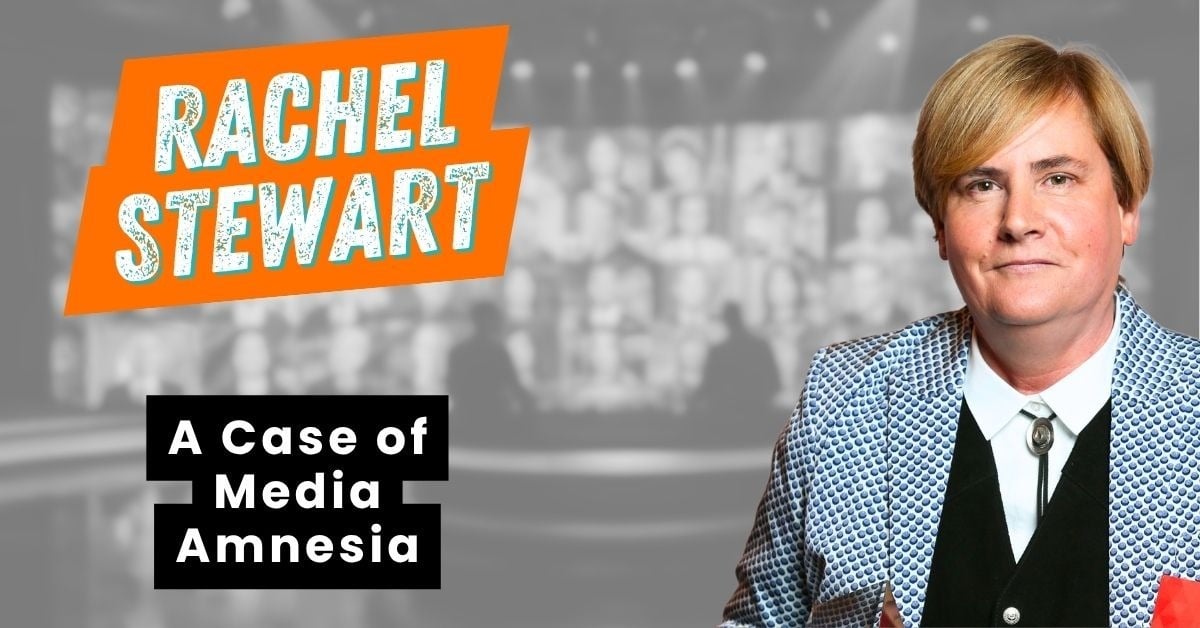
by Rachel Stewart
Have you heard of the Gell-Man Amnesia effect? You’ll recognise it when it’s described, I’m sure, because many of us willingly partake in it.
The term was coined by writer and filmmaker Michael Crichton, inspired by his friend, Nobel Prize-winning physicist Murray Gell-Mann, whose expertise was often misrepresented by the media throughout his career. The following quote comes from a speech Crichton gave in 2002.
“Briefly stated, the Gell-Mann Amnesia effect is as follows. You open the newspaper to an article on some subject you know well. In Murray [Gell-Mann]’s case, physics. In mine, show business. You read the article and see the journalist has absolutely no understanding of either the facts or the issues. Often, the article is so wrong it actually presents the story backward—reversing cause and effect. I call these the “wet streets cause rain” stories. Paper’s full of them.
In any case, you read with exasperation or amusement the multiple errors in a story and then turn the page to national or international affairs and read as if the rest of the newspaper was somehow more accurate about Palestine than the baloney you just read. You turn the page and forget what you know.”
For me, it was reading stories about falconry that confirmed that the various writers were either lazy, incompetent, or going for pure sensationalism. And you will have a field that you’ve devoted a big chunk of your life to that they will consistently cockup too. It’s beyond frustrating and instantly sobering when you see it.
I thought talking about it today was a timely reminder – as if we needed it – that a media outlet that consistently mangles topics or issues that we are extremely familiar with means that the odds are they’re not worth trusting on other subjects that we have little direct knowledge of. Or, in other words, we tend not to trust people who have a track record of lying to us but suffer a form of ‘amnesia’ when media continually does the exact same thing.
Why? I have several theories.
One, and most commonly, it takes mental effort. Taking a story at face value is easier for most, and people are generally time poor.
Two, there is a belief in some that journalists may find the sciences or physics too dense, but they will get the easier frameworks of politics or crime correct. That’s a big assumption, given what we know about political biases.
Three, idly consuming inaccurate news is seen by many as better that consuming no news at all. It’s like they feel the pull to stay abreast of national and global events for social acceptance but then end up repeating rubbish. This is extremely common, and don’t we know it.
Four, and more in the vanity arena, some just want to belong to a ‘tribe’. During Covid, for example, that tribe was ‘being a good citizen’, ‘community’ and ‘trusting the Government’ as the “one true source of information”.
Here’s Nick Freitas during a speaking tour only two days ago speaking to a rare rational and polite young questioner on some of this stuff I’ve just mentioned and, overall, the subject of trust in the media. Or lack of it.
Of course, algorithms and AI are changing the game again and forever. Truth is now ostensibly subjective, and your cognitive biases will steer you ever further towards media echo chambers.
I can only wish humanity well with that experiment. 1984, anyone?
All I can recommend is keep thinking, researching, and being real. And, whatever you do, keep listening to RCR. This is where the thinkers are, and we love having your company.
I’ll leave you with the wonderful Betty Hope. She’s the only ‘Hope’ I currently identify with.
Listen to the full episode of Riding Shotgun.
Our Contributor
