
by Joshua Riley
DPH advised ending vaccine passes for under-18s. Hipkins circled NO. The Ministry scrubbed its myocarditis line and filed parents' fears under “disinformation”, beside QAnon. Now he wants it in law.
Start with a number.
1 in 25,000.
That's the risk of myocarditis or pericarditis in the first 7 days after a second mRNA dose, for males aged 12 to 29, per US data. For males 30 and over: 1 in 420,000.
Not from some Telegram channel. From the Government's own vaccine advisers, CV TAG, to Bloomfield on 21 July 2021. Their advice: 16 to 29-year-olds should wait “at least 8 weeks” for the second dose, because “a longer interval between doses may reduce the frequency of some side effects.” [1]
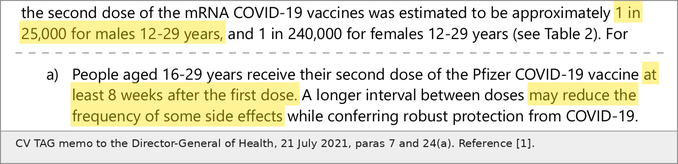
Young hearts. Higher risk. Space the shots. Tell people why.
That's a duty of care. It's the job.
Here's what they did with it.
The sales brief. Next day Bloomfield passed it to the Prime Minister. The Royal Commission records him noting that younger people were “already more vaccine-hesitant than older groups”, and that communications “would need to be clear that the benefits of the Comirnaty vaccine outweighed the risks.” [2]
A sales brief, not a disclosure plan.
The brakes. On 4 August CV TAG said the vaccine “should not be routinely administered” to 12 to 15-year-olds “at this time”, pending a review that included myocarditis in that age group. [3]
The U-turn. On 12 August the Government announced bookings would open to everyone over 16 from 1 September. That night the Chief Science Advisor emailed CV TAG: “Ashley and I have been thinking that it would be sensible to recommend actioning the Medsafe approval for the younger age group from that date as well.” [4]
CV TAG “convened by email” and agreed. The reasons recorded: equity, and fewer school closures. Myocarditis isn't mentioned. [5]
The 16 August Cabinet paper on 12 to 15-year-olds, from the office of the Minister for COVID-19 Response, Chris Hipkins, left out the 4 August advice to hold off. As released, it never says myocarditis. [6]
That's how you bury something in Wellington. You don't hide it. You just don't mention it.
The deletion. On 12 August the Ministry's media release on the six-week gap said the longer interval was “also consistent with” CV TAG's advice “to reduce the likelihood of a rare side effect of myocarditis or pericarditis”.
On 16 August it became “may reduce”. Fair enough.
On 26 August it was gone. The sentence now stops at “between doses.” [7]
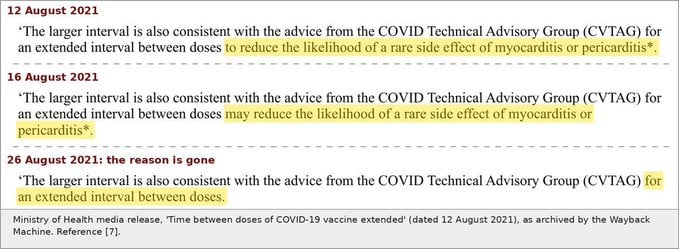
Ten days after they made it accurate, they took it down. Deleting a true sentence does one thing: it stops people reading it.
The advisers' minutes of 17 August:
“It was requested that references to increasing dosing intervals potentially providing some protection against myocarditis be removed from communications. This has been actioned.” [8]
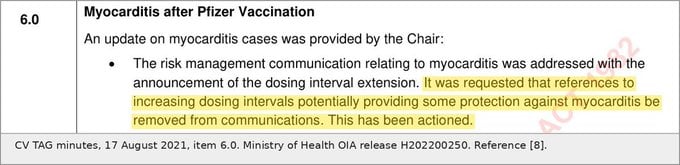
Requested by whom? The minutes don't say. The Ministry points to the advisers' own discussion and says it holds no other records. [4] But the re-wording was already done.
On 19 August the Prime Minister announced the 12 to 15 decision (“it is safe, and it's the right thing to do”), with eligible parents able to book their 12 to 15-year-olds in from the next morning. [9] A week after that announcement, the heart-safety reason came off the page.
Before the fact-checkers sprain something: yes, Medsafe issued a myocarditis alert in July, the Ministry put out more after the first myocarditis death, and Delta reached the community within a fortnight of the 4 August advice. [2] These aren't reasons to stop saying why the gap was longer.
The verdict. By December the passes and mandates were in force. Two doses, or no job, no café, no sport. [12]
What he knew. In August 2021 Hipkins chaired the Vaccine Ministers group. It was told the longer gap between doses was “for people under 30 years of age based on risk of myocarditis”. [17][18]
On 9 December CV TAG told Bloomfield that under-18 transmission risks “are insufficient to justify mandating a 2-dose schedule of the Pfizer vaccine prior to working in any environment”, and that certificates for under-18s fed informal exclusions, “disproportionately disadvantaging children against a minimal reduction in public health risk.” [10]
On 22 December a briefing addressed to Hipkins by name reported that CV TAG had “raised concerns about vaccine mandates requiring younger age groups (e.g. those under 18 years) to be fully vaccinated”. [19]
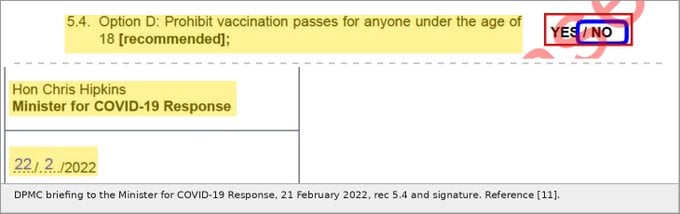
The NO. On 21 February 2022, a DPMC briefing gave him the advice of the Office of the Director of Public Health: moving over time towards no passes for under-18s “is the most proportionate and equitable approach”.
His advisers' concerns about two doses for kids had come in a briefing addressed to him.
He circled NO. [11]
The Royal Commission later called the two-dose rule for under-18s one of the “clear cases where the span of mandates went too far”. It also found the advice was not provided to the 12 to 17-year-olds living under it. [12]
The other front. In late July 2021, Facebook pulled the page of Voices for Freedom (VFF), saying it does “not allow false claims which public health experts have advised us could lead to Covid-19 vaccine rejection.” Among the group's questions: how Medsafe and the Government could “continue to defend the choice to inject our precious children with an experimental product.” [13]
Facebook says it acted on its own rules. But the state was no bystander in what came after. It had been planning since before the rollout. A DPMC briefing to the Prime Minister, dated 20 December 2020, preferred that countering disinformation be “primarily driven from outside of government”, noting that “perception issues” around government monitoring “could serve to reinforce conspiracy theories and narratives of state surveillance, censorship and enforcement”. Second on its list of ministers to flag disinformation to: the Minister for COVID-19 Response, Chris Hipkins. [17]
They knew how it would look. So someone else would be the face of it. By 2022 MoH had a disinformation team, DART, working with Netsafe. Its first monthly report, in draft, was on VFF. On “banned actors smurfing back on”, with “VFF being one”, it floated a way to “use the newly created code of practice to nudge them along (perhaps in the same way one uses a rolled up newspaper to nudge a wayward canine along).” Its draft report on VFF filed “COVID vaccines are experimental and harmful (particularly to children)” under disinformation. Then this:
“VFF's ongoing references to protecting children, ostensibly from vaccine harms, are a softening of the same message used by the conspiracy group Qanon” [14]

Nine months earlier, the Ministry's own advisers had told it that a young person's informed decision not to get a second dose “due to potential myocarditis risk is justified.” [10]
The advisers were allowed to worry about kids' hearts. A group that had the same worry got filed next to QAnon.
DART's own problem? “issues of free speech etc which make entry into this space problematic without a firm mandate to do so.” [14]
Remember that phrase. A firm mandate.
The mandate. On 17 October 2026, Law News reported Labour's plan for an Aussie-style “digital duty of care”: an “independent online regulator” and stronger “protections against harmful content”. [15] Hipkins was Minister for COVID-19 Response from November 2020 to June 2022. [16] Who decides what is “harmful”? As reported, it doesn't say.
That's what their “firm mandate” looks like.
We've seen Labour's duty of care. It's in the minutes.
A duty of care for your kid's feed.
None for your kid's heart.
The government owed children a duty of care, and failed them.
It already had the power to call things “disinformation”. It used that power to protect the campaign, not the kids.
Now the same party wants a regulator for “harmful content”, written into law.
No.
References
1. CV TAG, Myocarditis following vaccination: CV TAG recommendations on the use of the Pfizer vaccine, memo to Bloomfield, 21 July 2021, paras 7, 24.
https://www.health.govt.nz/system/files/2026-06/Myocarditis-following-vaccination.pdf
2. Royal Commission of Inquiry into COVID-19 Lessons Learned, Phase Two Main Report (26 February 2026), paras 343–355.
3. CV TAG, Priority groups for vaccination among 12- to 15-year-olds, memo, 4 August 2021, para 12(d)–(e).
4. Dr Ian Town, email to CV TAG members (copied to Bloomfield), 12 August 2021, and draft bullets of the CV TAG discussion, 13 August 2021, item 7: Ministry of Health OIA response H2026079967. Reported by The Centrist, “Were ministers following the science, or the politics, on teen COVID vaccinations? Pt 1”, 20 June 2026.
5. CV TAG, Extending age groups who can receive COVID-19 vaccine, memo to Bloomfield, 13 August 2021, paras 2–5.
6. Office of the Minister for COVID-19 Response, Cabinet paper Decision to use the COVID-19 Pfizer vaccine for children aged 12 to 15 years (August 2021), paras 15–17.
7. Ministry of Health, Time between doses of COVID-19 vaccine extended, media release dated 12 August 2021, as archived:
(12 August version);
(16 August);
(26 August).
8. CV TAG minutes, 17 August 2021, item 6.0: Ministry of Health OIA release H202200250, Appendix 2, p 6.
https://fyi.org.nz/request/16691-covid-19-vaccine-technical-advisory-group-meeting-minutes
9. Ministry of Health, COVID-19 update, 19 August(transcript), as archived:
10. CV TAG, Position statement: Vaccination mandates in those under 18 years of age, 9 December 2021, para 9.
11. DPMC, COVID-19 Response: Options for Ensuring Children's Access to Extracurricular Activities, briefing DPMC-2021/22-1478, 21 February 2022, para 9 and recs 5.2, 5.4 (proactively released).
12. Royal Commission, Phase Two Main Report, paras 413–418, 494–495, 511.
13. David Fisher, “Takedown: The slick anti-vaxxing group that just got banned by Facebook”, NZ Herald, 29 July 2021.
14. Ministry of Health OIA response H2022015932, 28 November 2022: emails of 8 September 2022, and draft Voices For Freedom: Content Assessment, September 2022.
https://fyi.org.nz/request/20989-communications-between-dart-and-netsafe
15. “Labour pledges immediate action on under-16s social media ban, proposes Aussie-style ‘digital duty of care'”, Law News, 17 October 2026.
16. New Zealand Gazette, notice 2022-vr2370 (Hipkins's COVID-19 Response appointment revoked, 14 June 2022).
https://gazette.govt.nz/notice/id/2022-vr2370
17. DPMC National Security Group, briefing Strengthening New Zealand's Resilience to Mis/Disinformation to the Prime Minister, 2021NSP/031, dated 20 December 2020, recommendations 3 and 5, and Attachment A.
Authorised by A Riley for Sovereign, [email protected]
Share This
by Joshua Riley
DPH advised ending vaccine passes for under-18s. Hipkins circled NO. The Ministry scrubbed its myocarditis line and filed parents' fears under “disinformation”, beside QAnon. Now he wants it in law.
Start with a number.
1 in 25,000.
That's the risk of myocarditis or pericarditis in the first 7 days after a second mRNA dose, for males aged 12 to 29, per US data. For males 30 and over: 1 in 420,000.
Not from some Telegram channel. From the Government's own vaccine advisers, CV TAG, to Bloomfield on 21 July 2021. Their advice: 16 to 29-year-olds should wait “at least 8 weeks” for the second dose, because “a longer interval between doses may reduce the frequency of some side effects.” [1]
Young hearts. Higher risk. Space the shots. Tell people why.
That's a duty of care. It's the job.
Here's what they did with it.
The sales brief. Next day Bloomfield passed it to the Prime Minister. The Royal Commission records him noting that younger people were “already more vaccine-hesitant than older groups”, and that communications “would need to be clear that the benefits of the Comirnaty vaccine outweighed the risks.” [2]
A sales brief, not a disclosure plan.
The brakes. On 4 August CV TAG said the vaccine “should not be routinely administered” to 12 to 15-year-olds “at this time”, pending a review that included myocarditis in that age group. [3]
The U-turn. On 12 August the Government announced bookings would open to everyone over 16 from 1 September. That night the Chief Science Advisor emailed CV TAG: “Ashley and I have been thinking that it would be sensible to recommend actioning the Medsafe approval for the younger age group from that date as well.” [4]
CV TAG “convened by email” and agreed. The reasons recorded: equity, and fewer school closures. Myocarditis isn't mentioned. [5]
The 16 August Cabinet paper on 12 to 15-year-olds, from the office of the Minister for COVID-19 Response, Chris Hipkins, left out the 4 August advice to hold off. As released, it never says myocarditis. [6]
That's how you bury something in Wellington. You don't hide it. You just don't mention it.
The deletion. On 12 August the Ministry's media release on the six-week gap said the longer interval was “also consistent with” CV TAG's advice “to reduce the likelihood of a rare side effect of myocarditis or pericarditis”.
On 16 August it became “may reduce”. Fair enough.
On 26 August it was gone. The sentence now stops at “between doses.” [7]
Ten days after they made it accurate, they took it down. Deleting a true sentence does one thing: it stops people reading it.
The advisers' minutes of 17 August:
“It was requested that references to increasing dosing intervals potentially providing some protection against myocarditis be removed from communications. This has been actioned.” [8]
Requested by whom? The minutes don't say. The Ministry points to the advisers' own discussion and says it holds no other records. [4] But the re-wording was already done.
On 19 August the Prime Minister announced the 12 to 15 decision (“it is safe, and it's the right thing to do”), with eligible parents able to book their 12 to 15-year-olds in from the next morning. [9] A week after that announcement, the heart-safety reason came off the page.
Before the fact-checkers sprain something: yes, Medsafe issued a myocarditis alert in July, the Ministry put out more after the first myocarditis death, and Delta reached the community within a fortnight of the 4 August advice. [2] These aren't reasons to stop saying why the gap was longer.
The verdict. By December the passes and mandates were in force. Two doses, or no job, no café, no sport. [12]
What he knew. In August 2021 Hipkins chaired the Vaccine Ministers group. It was told the longer gap between doses was “for people under 30 years of age based on risk of myocarditis”. [17][18]
On 9 December CV TAG told Bloomfield that under-18 transmission risks “are insufficient to justify mandating a 2-dose schedule of the Pfizer vaccine prior to working in any environment”, and that certificates for under-18s fed informal exclusions, “disproportionately disadvantaging children against a minimal reduction in public health risk.” [10]
On 22 December a briefing addressed to Hipkins by name reported that CV TAG had “raised concerns about vaccine mandates requiring younger age groups (e.g. those under 18 years) to be fully vaccinated”. [19]
The NO. On 21 February 2022, a DPMC briefing gave him the advice of the Office of the Director of Public Health: moving over time towards no passes for under-18s “is the most proportionate and equitable approach”.
His advisers' concerns about two doses for kids had come in a briefing addressed to him.
He circled NO. [11]
The Royal Commission later called the two-dose rule for under-18s one of the “clear cases where the span of mandates went too far”. It also found the advice was not provided to the 12 to 17-year-olds living under it. [12]
The other front. In late July 2021, Facebook pulled the page of Voices for Freedom (VFF), saying it does “not allow false claims which public health experts have advised us could lead to Covid-19 vaccine rejection.” Among the group's questions: how Medsafe and the Government could “continue to defend the choice to inject our precious children with an experimental product.” [13]
Facebook says it acted on its own rules. But the state was no bystander in what came after. It had been planning since before the rollout. A DPMC briefing to the Prime Minister, dated 20 December 2020, preferred that countering disinformation be “primarily driven from outside of government”, noting that “perception issues” around government monitoring “could serve to reinforce conspiracy theories and narratives of state surveillance, censorship and enforcement”. Second on its list of ministers to flag disinformation to: the Minister for COVID-19 Response, Chris Hipkins. [17]
They knew how it would look. So someone else would be the face of it. By 2022 MoH had a disinformation team, DART, working with Netsafe. Its first monthly report, in draft, was on VFF. On “banned actors smurfing back on”, with “VFF being one”, it floated a way to “use the newly created code of practice to nudge them along (perhaps in the same way one uses a rolled up newspaper to nudge a wayward canine along).” Its draft report on VFF filed “COVID vaccines are experimental and harmful (particularly to children)” under disinformation. Then this:
“VFF's ongoing references to protecting children, ostensibly from vaccine harms, are a softening of the same message used by the conspiracy group Qanon” [14]
Nine months earlier, the Ministry's own advisers had told it that a young person's informed decision not to get a second dose “due to potential myocarditis risk is justified.” [10]
The advisers were allowed to worry about kids' hearts. A group that had the same worry got filed next to QAnon.
DART's own problem? “issues of free speech etc which make entry into this space problematic without a firm mandate to do so.” [14]
Remember that phrase. A firm mandate.
The mandate. On 17 October 2026, Law News reported Labour's plan for an Aussie-style “digital duty of care”: an “independent online regulator” and stronger “protections against harmful content”. [15] Hipkins was Minister for COVID-19 Response from November 2020 to June 2022. [16] Who decides what is “harmful”? As reported, it doesn't say.
That's what their “firm mandate” looks like.
We've seen Labour's duty of care. It's in the minutes.
A duty of care for your kid's feed.
None for your kid's heart.
The government owed children a duty of care, and failed them.
It already had the power to call things “disinformation”. It used that power to protect the campaign, not the kids.
Now the same party wants a regulator for “harmful content”, written into law.
No.
References
1. CV TAG, Myocarditis following vaccination: CV TAG recommendations on the use of the Pfizer vaccine, memo to Bloomfield, 21 July 2021, paras 7, 24.
https://www.health.govt.nz/system/files/2026-06/Myocarditis-following-vaccination.pdf
2. Royal Commission of Inquiry into COVID-19 Lessons Learned, Phase Two Main Report (26 February 2026), paras 343–355.
3. CV TAG, Priority groups for vaccination among 12- to 15-year-olds, memo, 4 August 2021, para 12(d)–(e).
4. Dr Ian Town, email to CV TAG members (copied to Bloomfield), 12 August 2021, and draft bullets of the CV TAG discussion, 13 August 2021, item 7: Ministry of Health OIA response H2026079967. Reported by The Centrist, “Were ministers following the science, or the politics, on teen COVID vaccinations? Pt 1”, 20 June 2026.
5. CV TAG, Extending age groups who can receive COVID-19 vaccine, memo to Bloomfield, 13 August 2021, paras 2–5.
6. Office of the Minister for COVID-19 Response, Cabinet paper Decision to use the COVID-19 Pfizer vaccine for children aged 12 to 15 years (August 2021), paras 15–17.
7. Ministry of Health, Time between doses of COVID-19 vaccine extended, media release dated 12 August 2021, as archived:
(12 August version);
(16 August);
(26 August).
8. CV TAG minutes, 17 August 2021, item 6.0: Ministry of Health OIA release H202200250, Appendix 2, p 6.
https://fyi.org.nz/request/16691-covid-19-vaccine-technical-advisory-group-meeting-minutes
9. Ministry of Health, COVID-19 update, 19 August(transcript), as archived:
10. CV TAG, Position statement: Vaccination mandates in those under 18 years of age, 9 December 2021, para 9.
11. DPMC, COVID-19 Response: Options for Ensuring Children's Access to Extracurricular Activities, briefing DPMC-2021/22-1478, 21 February 2022, para 9 and recs 5.2, 5.4 (proactively released).
12. Royal Commission, Phase Two Main Report, paras 413–418, 494–495, 511.
13. David Fisher, “Takedown: The slick anti-vaxxing group that just got banned by Facebook”, NZ Herald, 29 July 2021.
14. Ministry of Health OIA response H2022015932, 28 November 2022: emails of 8 September 2022, and draft Voices For Freedom: Content Assessment, September 2022.
https://fyi.org.nz/request/20989-communications-between-dart-and-netsafe
15. “Labour pledges immediate action on under-16s social media ban, proposes Aussie-style ‘digital duty of care'”, Law News, 17 October 2026.
16. New Zealand Gazette, notice 2022-vr2370 (Hipkins's COVID-19 Response appointment revoked, 14 June 2022).
https://gazette.govt.nz/notice/id/2022-vr2370
17. DPMC National Security Group, briefing Strengthening New Zealand's Resilience to Mis/Disinformation to the Prime Minister, 2021NSP/031, dated 20 December 2020, recommendations 3 and 5, and Attachment A.
Authorised by A Riley for Sovereign, [email protected]