
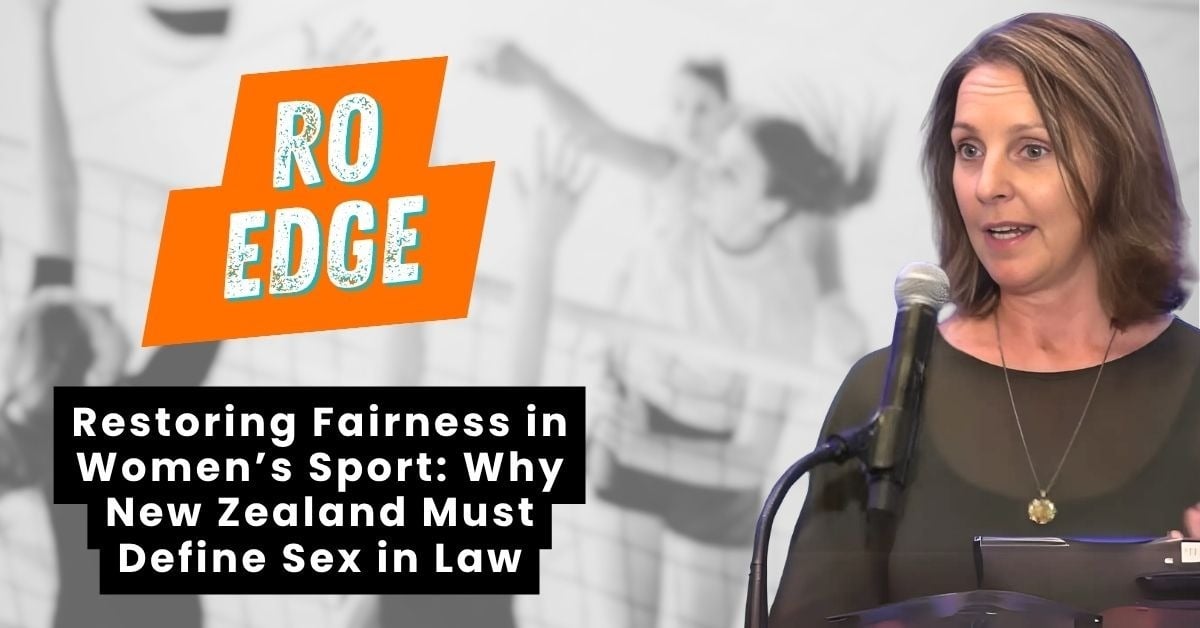
by Ro Edge, Save Women’s Sport Australasia
New Zealand stands at a crossroads. The Legislation (Definitions of Woman and Man) Amendment Bill, introduced by New Zealand First, offers a straightforward, common-sense solution: define “woman” as an adult human biological female and “man” as an adult human biological male. For those of us fighting to protect fair sport for girls and women, this bill is long overdue.
Biological sex is not a feeling or a self-declaration. It is an immutable reality rooted in reproductive biology. Females are the sex organised around the production of large gametes (ova); males around small gametes (sperm). This binary distinction underpins every meaningful category in sport – strength, speed, power, endurance, and injury risk. Without clear legal definitions anchored in biology, male-bodied individuals continue to enter women’s and girls’ categories, displacing female athletes at every level.
We have already seen this happening in New Zealand: male competitors in girls and women’s sports, including football, cricket, cycling, swimming, netball, cross country, waka ama, mountain biking, weight lifting and roller derby. The pattern is consistent – lost medals, shattered records, eroded confidence, and girls and women quietly walking away from the sports they love. Community and school sport, where most females participate, suffers the most. Elite levels simply expose the unfairness in stark numbers.
This is not compassion. It is the predictable result of policy that ignored material reality. Sport New Zealand’s self-ID approach, enabled by earlier legal vagueness, has failed women and girls. Clear definitions in the Legislation Act would restore the foundation for single-sex categories across all statutes – including sport, changing rooms, and safeguarding policies.
The bill needs strengthening to be fully effective. It should explicitly define “sex” by reproductive role, include “girl” and “boy,” and ensure these definitions apply consistently across the statute book. As Ani O’Brien rightly argues in her submission to NZ Firsts bill, a reproductive-role definition is scientifically robust, objective, and durable. It accommodates natural variation and rare disorders of sex development without erasing the two-sex reality that makes sex-segregated sport necessary in the first place.
What makes this modest reform so contentious is the unbalanced lobbying against it. According to the 2023 Census, only 0.7% of New Zealand adults identify as transgender. Yet a small but highly organised network of taxpayer-supported rainbow organisations has mobilised with remarkable coordination and influence. Groups receiving millions in public funding for “inclusion” training and advocacy have flooded submissions and public commentary with claims that biological definitions are “harmful” or “discriminatory.” Independent investigative journalist Penny Marie has highlighted how this push comes disproportionately from ideologically driven NGOs rather than the broader rainbow community or ordinary New Zealanders.
As Penny Marie has observed, the backlash follows a uniform script designed to blur sex and identity, keeping the legal categories contested. Meanwhile, the vast majority of New Zealanders – including many gay and lesbian citizens – simply want common sense restored.
In our view, the law can and should acknowledge biological reality while allowing compassionate accommodations where genuinely needed. Defining sex does not deny anyone’s dignity. It simply protects the hard-won sex-based rights and opportunities that women fought generations to secure – especially the right to fair and safe sport.
Fairness in sport is not negotiable. Male advantage does not disappear with hormones, declarations, or wishful thinking. Girls and women deserve categories based on biological sex – in every school, club, and competition. Anything less is discrimination against half the population.
Public submissions on the bill close at 11:59pm on Thursday, 2 July 2026. This is our chance to tell Parliament that women’s sport matters, that biology is real, and that common sense must prevail over unbalanced ideology.
Support the bill. Urge stronger, explicit biological definitions. Demand that sport – and the law – once again prioritises fairness, safety, and reality for New Zealand’s girls and women.
The time to speak is now.
Our Contributor
