
by Simon O'Connor
Recently, I was invited to Brigham Young University (BYU) in Utah to give a talk on religious freedom and belief. It was part of a legal symposium organised by The International Center for Law and Religion Studies at Brigham Young University’s law faculty. It was an amazing experience on so many levels, including interacting with various judges, lawyers, clergy, academics and practitioners from across the world and from a wide variety of faith traditions.
The symposium was titled – Building Paths to Flourishing: Regional, National, and International Protections of Religious Freedom. Below is the paper I delivered for those interested. Let me know your thoughts.

Introduction
While from New Zealand, I wanted to start my contribution from a Pole and someone who only ever visited the shores of my country once – Karol Wojtyła, or better known as Pope John Paul II. In an address to the United Nations in 1995 he said:1
“Our respect for the culture of others is therefore rooted in our respect for each community’s attempt to answer the question of human life. And here we can see how important it is to safeguard the fundamental right to freedom of religion and freedom of conscience, as the cornerstones of the structure of human rights and the foundation of every truly free society. No one is permitted to suppress those rights by using coercive power to impose an answer to the mystery of man. To cut oneself off from the reality of difference — or, worse, to attempt to stamp out that difference — is to cut oneself off from the possibility of sounding the depths of the mystery of human life.”
He would argue, as would I, that freedom of religion – or freedom of belief, freedom of conscience – is the seminal and foundational human right. It is the right on which all other rights find their grounding, from freedom of speech to freedom of association.
New Zealand Context
Paradoxically though, in New Zealand, this foundational right is both ignored and being undermined. It is important to note that New Zealand still has religious freedom and is not facing an authoritarian or coercive suppression. Instead, I believe we are witnessing a slow degrading of this freedom and consequently a challenge to all fundamental human rights.
It is early days in New Zealand as compared to some other democratic nations, but symposia like this, and the ability to both clearly articulate what is happening and then discuss ways to counter the decline, are vital.
To illustrate, I might turn to a few anecdotes from time as a Member of Parliament in New Zealand. During the Covid years, as in many jurisdictions, the government sought substantial powers to manage the situation. In New Zealand, many fundamental individual rights were limited or removed in the name of protecting the community. At that time, and as much the philosopher in me as a Member of Parliament, I was curious what consideration the government of the day had given to its decisions considering New Zealand’s Bill of Rights Act 1990.2
What was striking is that freedom of religion was never considered by Ministers when making decisions, including when ordering the closure of churches and other places of worship.3
Other rights were considered, but not religious freedom. This was not due to oversight, but what I would argue is a growing belief in New Zealand that the right to religious freedom is outdated, unwanted, and irrelevant.
This was echoed in the courts recently, when the judge rejected the importance of religious freedom and conscience rights for a group of doctors and health professionals around abortion.4
Her judgement undermined religious freedom by suggesting that because there is debate on ethical questions within religious traditions, people – such as these doctors and nurses – cannot state that their belief is a matter of religious freedom. Put another way, the judge was saying that religious freedom can only be manifest if all adherents of that belief think the same. It is an extraordinary judgement yet illustrates both the hostility, and arguably contempt, of religious freedom in New Zealand.5
As I noted, freedom of religion is not seen as a fundamental human right in New Zealand. Religious belief is viewed as very much a private matter and consequently not requiring collective protection by the State.
Within the charity space, many do not see advancement of religion as relevant or charitable. The government of the day is exploring changes to charity taxation, particularly focused on religious groups. Much of the commentary is how religious belief is private, irrelevant in the modern world, and deserving of little to no protection.
An advocacy group I work for, called Family First, promotes among other things, traditional marriage. Its charitable status was revoked when Justices of the Supreme Court decided this view on marriage and family was no longer compatible with the social norms of New Zealand. This is a dangerous and monological view in what should be a pluralistic society. While not strictly a case of religious freedom, it does send a warning to those who hold traditional religious values that the courts will not side with them.
Alongside all of this is also a growing paganism in New Zealand that is celebrated by many on the progressive left as an act of decolonisation. The Christian faith, in particular, is being sidelined and indigenous pagan rites given preference. While some may argue that this is still captured by religious freedom, I would simply argue from history and theology that paganism decreases freedom, not enhances it. It has also been the Judeo-Christian understanding of ‘person’ that has directly led to the development of the human rights we enjoy today.
There is much more that could be shared, but I hope these quick examples are indicative of how religious freedom in New Zealand is being challenged and as I keep noting, viewed as irrelevant.
The Path Forward
Our question therefore, is how we turn this around or at the very least abate the current trajectory of decline. New Zealand is often in the fortunate position of learning from experiences in overseas jurisdictions, and this is key reason for attending this important symposium.
Firstly, we need to continue stressing the value of religious freedom into the public square. Each of us has a role to play. Religious belief, our consciences, are the essential and foundational right of a pluralistic society. I would suggest it begins with the everyday discussions we have with family and friends, work colleagues or those we happen upon during our daily activities. When questions of religious liberty are raised, we need to speak positively of them and not avoid what is, often times, seen as an awkward conversation.
From this foundation, speaking into the wider public square is necessary both positively and reactively. This manifests by ensuring, when opportunities arise, to speak to the value of religious freedom in everything from our school boards and professional organisations, through to our parliaments and senates. Reactively, we must speak up when governments or others look to limit or curb religious freedom. Too often, people make erroneous excuses for silence via suggestions of ‘a separation of church and state’; or we must “render to Caesar what is Caesar’s …”6 These are false interpretations of both these concepts. The place of religious liberty is to be defended in the public square.
Religious leaders need to unambiguously speak in defence of their faiths and the freedoms they are given. Too often, they sideline themselves suggesting the State has the right to limit freedoms and that the Church will survive. This is to fundamentally misunderstand human rights, which are God given and inalienable. The State’s role is to secure those rights, not create or disband them.
We also need to protect the rights downstream of religious freedom, in particular freedom of speech. As we are witnessing in much of the world, the beliefs of some are being suppressed to appease the counter beliefs of others. This is particularly true in discussions around marriage, family, and gender identity. New Zealand for example has passed conversion therapy laws which stifle any discussion other than affirmation of gender ideology.
Finally, although the most important, we need to pray. If we hold a Christian belief, then we also understand that God has won the victory upon the Cross of Calvary and his resurrection three days later. We need to pray publicly too. I don’t mean prayer as protest which is becoming an issue in the West, but prayer that is public, peaceful, and poised. It may be something as simple as a grace before every meal, whether at home or in a restaurant, or simply offering to start a meeting with a prayer.
I conclude with one final and simple point – freedoms exist to be exercised.
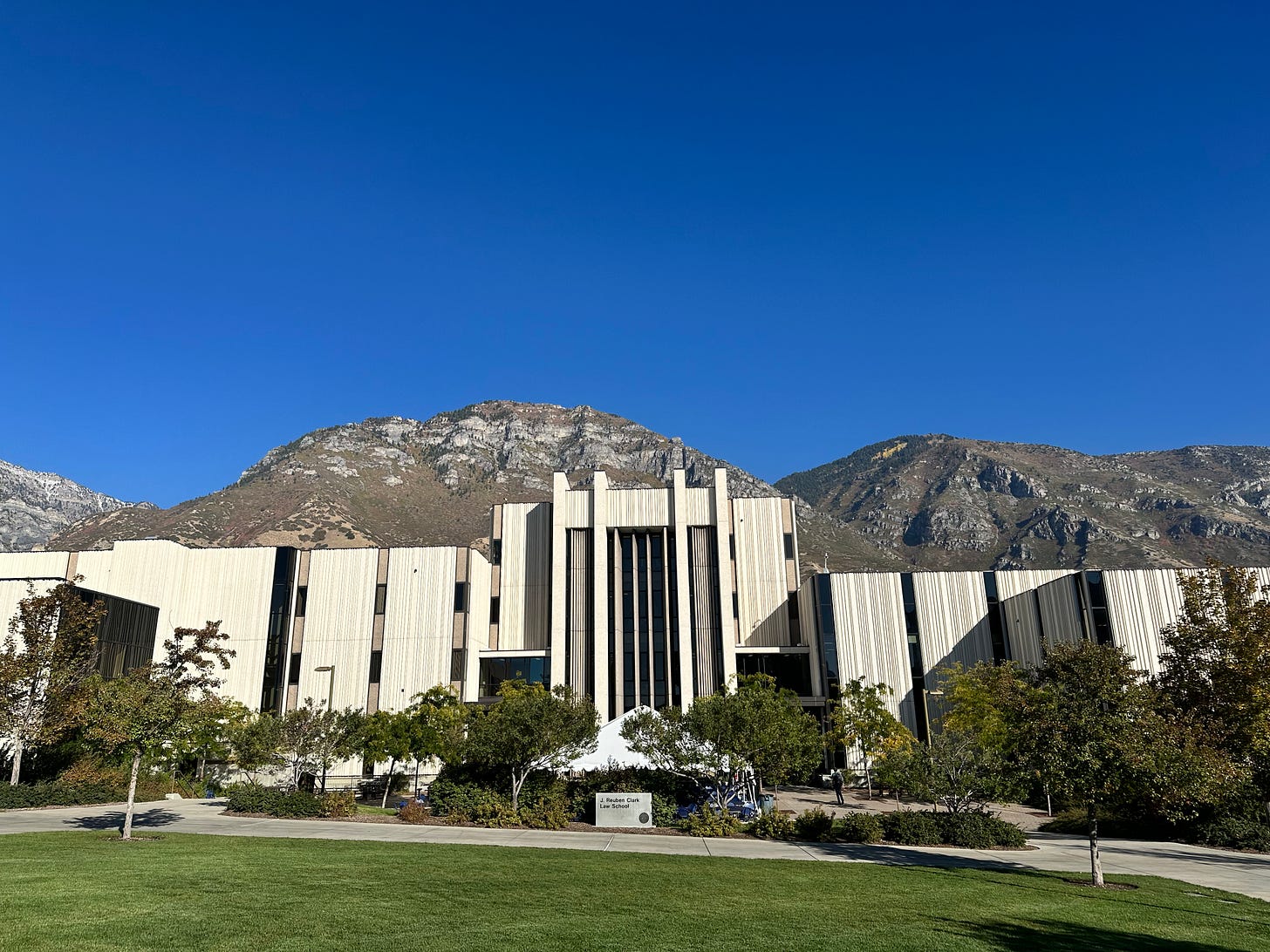
The Law School at Brigham Young University, Utah – not a bad location! The next day those mountains were covered in snow.
https://holyseemission.org/contents/statements/address-of-his-holiness-john-paul-ii 1995.php#:~:text=A%20decisive%20factor%20in%20the,freedom%2C%20peace%2C%20and%20solidarity
https://www.legislation.govt.nz/act/public/1990/0109/latest/DLM224792.html
https://www.parliament.nz/en/pb/hansard-debates/rhr/document/HansS_20200512_051000000/11 question-no-11-health and https://www.parliament.nz/en/pb/hansard debates/rhr/document/HansS_20200513_051480000/12-question-no-12-health
https://www.justice.govt.nz/jdo_documents/workspace___SpacesStore_2b9f7115_9efc_4bf6_820a_938 dba1bb78d.pdf
For further commentary, see https://www.ethosalliance.nz/articles/nz-health-professionals-alliance-v attorney-general
Gospel of Mark, 12:13; Gospel of Matthew 22:21
Our Contributor
