by Lisa Jane Spencer
If you are aware of the political space in Australia (and really all Western nations), you would not be able to ignore the conversations around opposing immigration, foreign influence and foreign ownership, which have led to a rise in the “Australia First” stance.
From the March for Australia nationwide protests (image above) to the political commentators online shouting into their phones, to The Noticer News & The Yarn highlighting foreign influence in our government and foreign crimes, to now the rise of One Nation.
This political stance asks us to filter everything with, “Is this beneficial to Australia and the Australian people?”
“Australia First” should be easy enough to understand, as it used to be the stock standard, but unfortunately it seems today we have a mixed bag of definitions of what Australia is and what an Australian is.
Changing a definition of a word is not unheard of and is indeed one of the most common tactics used to drive social and political change. This is called:
Persuasive redefinition
A specific type of definition that changes the descriptive meaning while keeping its emotive meaning (the positive or negative feeling attached to it) the same.
For example: Sex/gender. Biological sex (male/female, determined by chromosomes and reproductive anatomy) was long treated as binary and fixed (minus the very minority cases of intersex). Government and institutional language in many countries now treats “gender” as a self-identified social category that can diverge from sex. Though this change came in stages: first, it was adding words to distinguish a difference; for example, “trans-woman” (a man who identifies as a woman) and “cis-woman” (a biological woman). And then it progressed to: “A trans woman is a woman”. Which then led to the final boss of: “You must accept anyone who identifies as a woman, as a woman”. This led to social and political changes in sports, prisons, bathrooms, medical records, and laws.
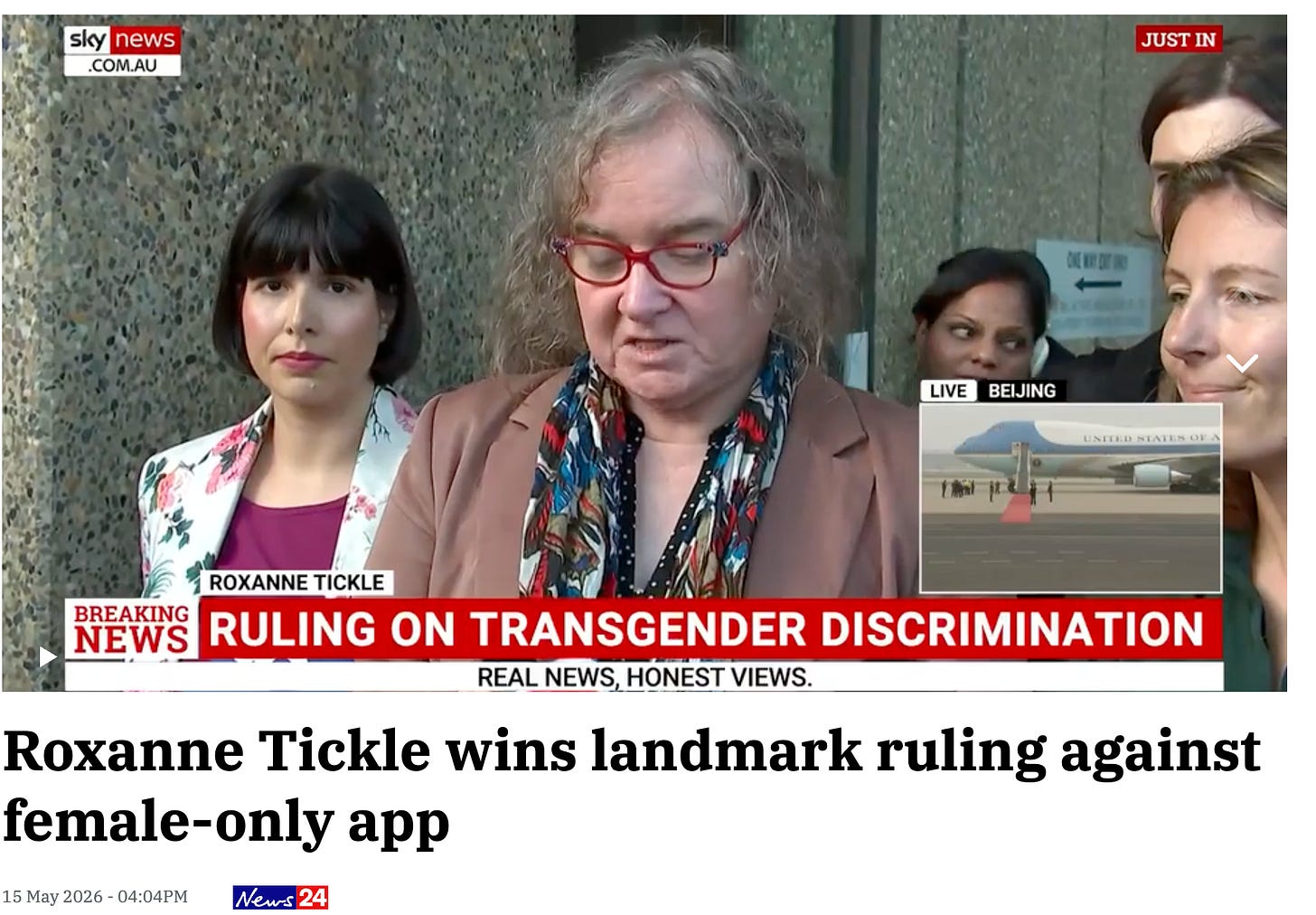
“Roxy Tickle” winning against Sal Grover, the creator of the app, for discrimination.
See, first it was “What is a woman?”
Now it’s “What is an Australian?”
A “nation” was always universally understood to mean a populace bound by common blood, ancestry, and territory. The word itself comes from the Latin word natio, meaning “birth,” “tribe,” “breed” or “race.” It quite literally means we are a people bound by shared ancestry, language, customs, history, and territory.
But changing a definition doesn’t just happen overnight. First, it’s a split in the definition, as it was in the trans agenda. Within nationalism, it’s now split into “ethnic nationalism” and “civic nationalism”.
The Split – Civic & Ethnic Nationalism
The original definition of “nation” is now used as the basis of the definition of “ethnic nationalism” (bound by shared ancestry, inherited language, or culture). Whilst a new type of nationalism, “civic nationalism”, is distinguished by being bound only by political principles, laws, and citizenship. This separation reveals that the definition of “nation” is in the process of being changed. You can’t just change a definition one day, because people won’t accept it. You have to first divide it, and in doing so, subvert it.
The Change – From policy to population
This split and change in definition has also meant a change in laws, policies and of course, demographics. Our nation has shifted from ~95% Anglo-Celtic to about 54-60% in just 70 years. Objectively, the change began with the breakdown of the White Australia Policy in the 70s.

The White Australia Policy was a collection of historical legislative and administrative measures designed to stop non-European immigration and maintain a predominantly white, British national character in Australia
‘Diversity is our strength’ – Introducing Modern Australia
Government and institutions now refer to Australia as “modern Australia”, which is described as a “multicultural nation” where “diversity is our strength”. India and China are now our largest sources of immigrants.

The practical consequences follow: high and continuous immigration from all kinds of ancestral backgrounds, reduced pressure to assimilate, parallel communities (ethnic enclaves) and a weakening of the older idea that the nation belongs primarily to the descendants of those who formed it: the British.
Whilst most people will still imagine an Australian as a white person (even if they don’t want to admit it), under this new “Modern Australia”, our institutions define an Australian primarily through citizenship rather than race and ancestry.
It’s a funny thing, though, because somehow we have: Greeks being called “Greek-Australian”, Indians being called “Indian-Australian”, Jews as “Jewish-Australian”, and Chinese as “Chinese-Australian” and so on. If we truly believed they were all “Australian”, they wouldn’t need to add the hyphenated identity. But see, the reason why this happens is that as humans, we are tribalistic.
Tribalism – Why the old meaning persists
We possess a strong, instinctual loyalty to one’s own group (the in-group) combined with a tendency to be suspicious, dismissive, or hostile toward people outside of it (the out-group). We naturally spot differences and similarities very quickly, and we determine who is “us” and who is “them”. We then prefer to be around our own and distinguish ourselves even more.
Whilst lefties will continuously spout that “race is a social construct”, race and ancestry are incredibly distinct and often something we separate ourselves by very naturally. Not only do our biological differences show up in our appearance, usually quite noticeably, but there are also measurable physiological and statistical differences that appear in laboratory and clinical tests.
Tribalism is also in line with our mating patterns and preferences. We are naturally more inclined to have offspring with someone who is of the same race and who is genetically similar to us (Racial Preferences in Online Dating across European Countries).
Australian: An Anglo-Celtic person born in Australia
So now we have established that whilst the establishment wants to change the definition of what an Australian is, it seems we are not quite fools (yet) and we understand what it always was: an Anglo-Celtic person who is born in Australia. Typically this aligns with their ancestors being either convicts or settlers. Though this sometimes becomes a “who has been here longer” kind of argument, the reality is that there isn’t a lot of difference between an Australian whose grandparents arrived from England 70-100 years ago and an Australian whose great-great-great-great-grandparents arrived from England 200 years ago. Because Australia is a British colony, and we are of the same ancestry.

The Rise of One Nation
Through the rise of disdain for the new and divided “Modern Australia”, One Nation is seeing a massive rise in popularity. A political party that began in the 90s which had a reputation for being pro-Australia and anti-foreign immigration, is now finally seeing a rise in popularity.

Image above: March for Australia demonstrates the impact of their grassroots nationwide protests on One Nation’s popularity.

Statement on One Nation’s website:
“We are a party that stands for Australia and Australian values.”
The writing is on the wall there. Sure, they’re standing for Australia, but… who are the people who make Australia? People who are Australian, or people who just have “Australian values”?
“I’m not racist! It’s about the culture and values”
I’ve had this conversation with a One Nation senator before (Malcolm Roberts who is pictured above), and it was the same. I have heard and seen the same rhetoric from many supposed “Australia first” politicians and commentators. They say, “it’s about the culture and values”, to which, when you ask them to define, they say things like “mateship”, “having a fair go”, “Anzac Day”, “convicts” and maybe some of the courageous might add “Christian values”. Or they might even add the subversive “Judeo” in there for some extra sparkle.

Limits – Civic nationalism
When one just speaks about Australian culture or values, this is the split in the definition of “nation” at play. This is the civic nationalist definition. When you draw out this argument to its absolute conclusion, civic nationalism says Australia will still be Australia if we import 1 billion Indians or Africans because “they have our values”, “embrace our culture” and are even perhaps “committed to Australia”. Civic nationalism either completely disregards biological differences between races, which dictate our behaviours, values (and therefore the whole state of a nation); or it assumes a “magic soil” theory, where someone is completely impacted and controlled by their environment rather than biology. Nurture over Nature.
I reject this, and I reject civic nationalism. Because it ultimately is not true.
Whilst I know there are some people who do not fit the definition of Australian, who also contribute to and love our nation, who also may use an added hyphen to their identity; this type of person cannot be the rule.
The exception, not the rule.
In fact, this type of person must acknowledge that the more of them, the less of Australia it will be. The country they or their parents or Grandparents came to for a better life will become more like the country they left.
If anyone can be Australian, then no one can be.
Australian must be an exclusive label; otherwise, we risk losing our nation and therefore our people. Everyone knows that if I moved to India and abided by their laws, their culture and values, I would not suddenly become an Indian.
When the trans agenda changed the definition of sex/gender, we lost rights to our own spaces; we lost the right to have autonomy over our own children; we lost our freedom of speech and so on. And now, as the “multicultural” agenda changes the definition of nation, we lose so much more…We lose our country, our rights, our freedoms, and we enter: Globalisation (and this is a whole article in itself).
So don’t be fooled here by definitions. In fact, be aware of them. Because if you cannot define it, you cannot defend it.
To defend it, you need to define it
Years ago, I once used the term “cis-woman” to describe myself in an interview because at the time I didn’t understand what was going on. At the time, I was a young musician sucked into abiding by the woke mentality that Triple J enforced to be in their “in club.” I would never again say this to describe myself because adding “cis” is the first step before changing the whole definition of woman and gender entirely. It becomes a slippery slope. There is no such thing as a “trans woman”; It’s just called a man who claims they are a woman, and a “cis woman” is just a woman.
Subversion
Civic nationalism is similar; It’s subversive and a dilution of a nation. And using “ethnic nationalism” is just as subversive in my opinion (though I know a few will disagree). I think “Nationalism” works just fine. Adding “ethnic” to me is the step before changing the whole definition of nation entirely. Whilst civic nationalism exists and very much thrives right now as a political idea, it has twisted what a nation always was by definition. And I’d argue that civic nationalism cannot truly exist; It begins as many groups of people wanting to live on the same land where they will all abide by the same culture (monoculture) and laws. However, eventually tribalism will kick in, and each group fights for their own group, their own laws and their own culture. Balkanisation is the outcome.
So if a “Australia First” politician or political commentator cannot define what an Australian is besides “values” and a “love and commitment for Australia”, then they cannot actually be Australia first.
And that is the litmus test.
Save Australia. Don’t be a civnat.
Originally published on Lisa’s Substack.
Our Contributor
