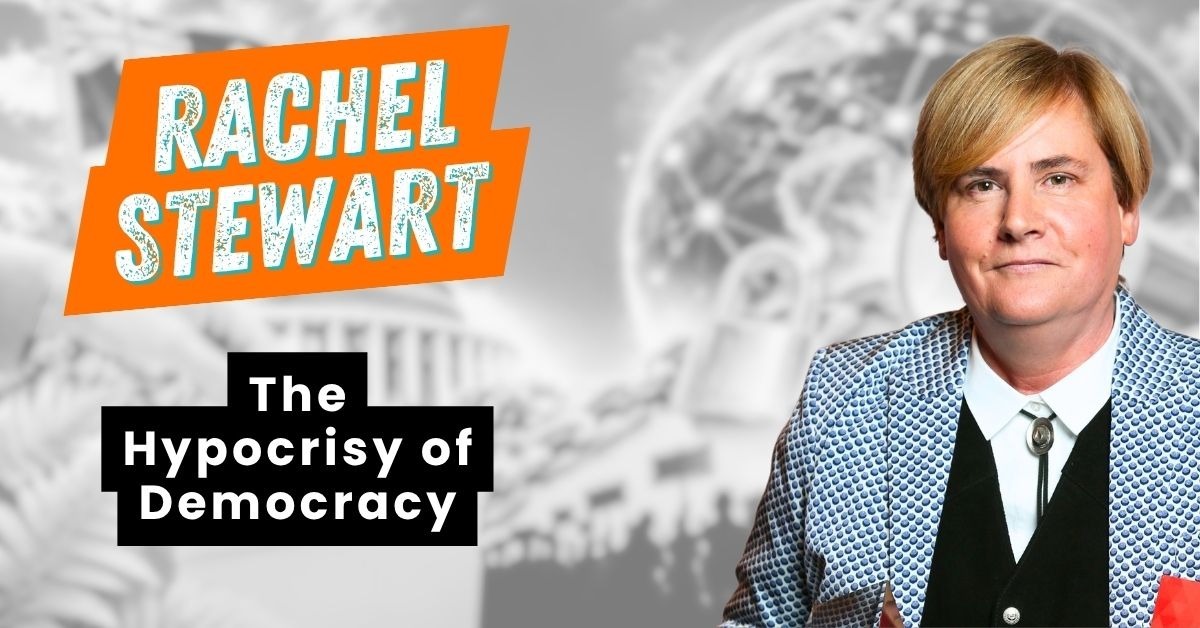
by Rachel Stewart
Two more sleeps until the election, and already well over a million New Zealanders know their own mind and have already voted. Good on them.
Voting is good, voting is right, and voting is crucial in a democracy. But here’s the nagging feeling in the back of my mind. Against the cringy backdrop of politicians shadowboxing with small children, eating ice creams, and dancing like David Brent is a world increasingly gone mad. On one hand, it’s quirky and small-townish that our politicians still act like clowns, but on the other, it’s kind of ignoring the iceberg looming on the starboard side.
The question therefore has to be: are we all still operating in a democracy? Or is it ostensibly just a polite dictatorship? I mean, if nothing else, the Covid years taught us something about that – and it wasn’t even polite. Far from it.
And what about the Trump years? What it proved was that the “other side” could simply not accept that their fellow Americans in flyover country voted for their nemesis. I had to be rigged. Which is what many red voters also said when Biden won in 2020. Elections are a great concept until they’re not.
Already we see the western version of democracy starting to shatter. Increasingly, many of us don’t trust it. But democracy keeps you addicted because it does deliver something irresistible. The belief that you matter, that your vote counts and that a nation’s problems can be solved with your help. It’s noble and just a plain lovely idea.
Except, again, some of us saw very clearly during the tyranny of the Covid response that so-called democracy is a useful foil for masking – excuse the pun – societal oppression. I mean, people were overtly forced to take an unproven, untested vaccine just to keep their jobs. That’s oppression in my book.
We are also facing an ever-growing freedom of speech crisis whereby expressing your opinions publicly about hot political topics that the politicians don’t want you talking about may see your legal firearms seized, or losing your job for sharing those opinions, and even denial of entry into other countries. The loss of free speech is the perfect harbinger of even worse times ahead.
Such persecution means underground movements form because citizens learn the hard way that sharing their thoughts is dangerous, while regimes concurrently will encourage protest movements, tolerate petitions and select committees, and provide elections to give the veneer of democracy and allow the peasants to blow off some steam. Which we do. We become extremely exercised about the whole charade. And after the relief of it all, are any entrenched power structures threatened really?
We get to vote against the politicians we don’t like, and that feels good. But because we vote for the ones we like and often get them, we are not psychologically predisposed to thinking how incredibly substandard they can turn out to be at the job because we chose them. That helps the framework stay firmly in place. It’s genius, actually.
Of course, it’d be entirely wrong of me to say that there are not some great features built into democracy. That the people’s will can create competition and incentives to serve public interests is one of them, and, in general, democracy does manage leadership transitions peacefully. Institutional checks on power are also pretty handy.
But have you noticed those “checks” starting to crumble? I have. And I’m also seeing a breakdown in Governments listening to the will of the people. What we are going through right now is a global push for less of that and not more of it. The old world order is steadily being replaced by something hard to describe. And, yes, some of those old institutions are not fit for purpose any longer. I’m thinking here of the UN as one robust example of being past its use-by date.
But what we are seeing and are now slowly realising, which is being enthusiastically ushered in by the globalists, is a whole new world that most Western nations – aside from the United States right now – think is optimum. No borders, mass immigration, no difference between the sexes, digital currency, the death of free speech – everything I spend many nights tossing and turning over. It feels like an explicit strategy and not just some random outcome of overcooked capitalism and diminished resources.
And when you start seeing democracy for what it isn’t, you can participate more strategically and less emotionally. When you understand that you are being cognitively manipulated, you grow some resistance to it.
And because of that, voting strategically – as many of us are doing this election – is a sane, acceptable, and entirely legal response no matter how anybody tries to paint it to the contrary. I’m looking squarely at the mainstream media and social media algorithms when I say that.
So go forth, my fellow citizens and vote using your strategic brain and not your fickle heart.
Listen to the full episode of Riding Shotgun.
Our Contributor
