

by Joshua Riley
The Crown owns half of AgriZeroNZ and reads its books every quarter. Parliament has never seen a page. That’s the structure working exactly as it was built.
About half of New Zealand’s emissions come from farms. The Crown created AgriZero to experiment with methane inhibitors, vaccines and low-methane genetics to meet the goals of Net Zero.
On 5 October 2026, AgriZeroNZ announced it had raised another $117 million.
That takes the total to $308 million, with a future goal of $450 million. The Government matches private money dollar for dollar, so on the company’s own statement, something like $154 million of that is public capital.
Ten days later, the Minister of Agriculture put it in writing that he has never sought advice on the only power that would let Parliament look inside it.
Not considered and rejected.
Never sought.
Luxon pointed to the opaque AgriZero programme as a reason he’s committed to Net Zero. The country is expected to trust a programme that can hide its own financials. A scheme which the government appears reluctant to investigate.
What Parliament gets for $154 million
Centre for Climate Action Joint Venture Limited trades as AgriZeroNZ. It was incorporated in January 2023 to fund technology that cuts methane and nitrous oxide from farming. Of its 19,100 ordinary shares, 9,550 – exactly half – are registered to “His Majesty the King acting by and through the Minister of Agriculture and the Minister of Finance.”
For all of that, Parliament receives two things.
The first is a number: the book value of the stake, sitting in the Ministry for Primary Industries’ annual report at $55.992 million as at 30 June 2025.
The second is a single performance measure against the appropriation. Here it is, in full.

“Invested in at least 3 ventures per financial year.” The answer was four.
That is the entire reporting line between this company and the House of Representatives. No annual report. No statement of intent. No statement of performance expectations. Nothing the company itself is obliged to put in front of anyone.
A count of investments. Three would have passed.
How you build something Parliament cannot see
In August 2022, Treasury put two options to the Minister of Finance in report T2022/1688.
Option one was a company listed in Schedule 4A of the Public Finance Act. Treasury said why it wanted that, in the document: “the established transparency, Crown ownership, and accountability framework afforded by Schedule 4A provisions.”
Option two was an ordinary Companies Act company, outside that regime. MPI and the industry partners preferred it.
Option two won.
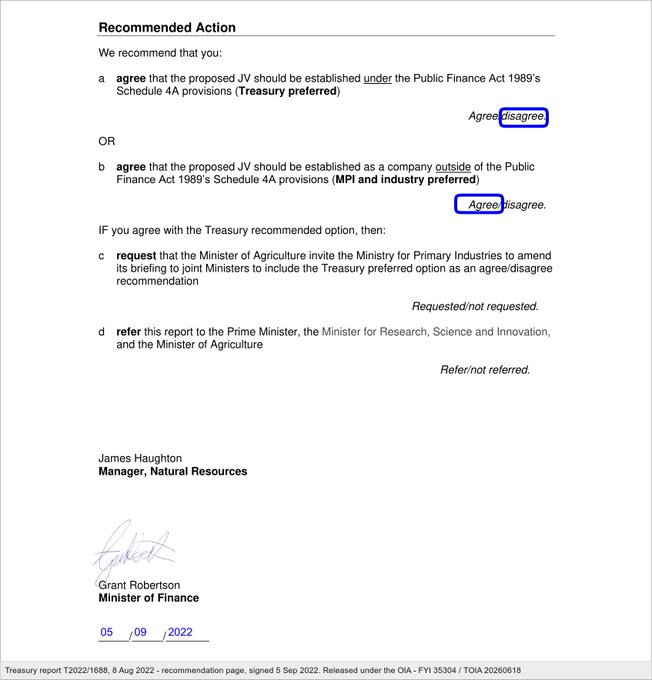
“Disagree” is marked against Treasury’s option. “Agree” is marked against the one outside Schedule 4A. Grant Robertson’s signature sits underneath, dated 5 September 2022.
The entity form was a decision for a group of delegated Ministers. And Treasury’s actual reasons for preferring Schedule 4A are still withheld, four years on, under the free and frank ground.
So we can see what they chose, but we aren’t allowed to see the argument against that choice.
A company can only be added to Schedule 4A (which would have provided transparency) if the Crown were to hold “more than 50%” of the shares. The Shareholders’ Agreement signed that December fixes the Crown at exactly half, in terms: “the Crown’s shareholding in the Company is to remain at 50%.”
Equal partnership and the statutory accountability regime could not both exist. That was a conscious choice.
Schedule 4A is not a label
It is worth being precise about what option two actually cost, because three separate statutes hang off that schedule.
Section 45OA of the Public Finance Act applies to Schedule 4A companies the Crown Entities Act provisions requiring a constitution to be presented to the House, plus the entire reporting code in sections 136 to 157A. Statement of intent. Statement of performance expectations. Annual report. Audit.
Schedule 1 of the Public Audit Act 2001 makes “Companies named in Schedule 4A of the Public Finance Act 1989” public entities. The Auditor-General would have been this company’s auditor by operation of law. As it stands, she audits MPI’s figure for the stake. She does not audit the company.
Standing Orders define “Crown entity”, for annual review, to include Schedule 4A entities. Standing Order 353 then hands every one of them to a select committee, once a year, to be asked questions.
One decision closed all three.
What Cabinet was told
In December 2022, Labour’s Cabinet was given a paper. Paragraph 25 promised that the Crown’s rights and interests, “and the need for appropriate transparency and accountability consistent with the Public Finance Act (1989) and Crown Entities Act (2004), will be secured through incorporation in the shareholders agreement and reservations in the Company constitution.”
Secured. That was the promise.
Treasury had already designed the substitute. It advised MPI on “the minimum provisions we think are necessary to be applied to a company outside of Schedule 4A to replicate key aspects of the PFA’s transparency and accountability framework,” including a statement of intent and a statement of performance expectations.
And then, in the very same report, Treasury wrote this.
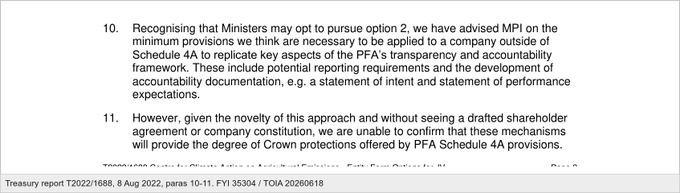
“We are unable to confirm that these mechanisms will provide the degree of Crown protections offered by PFA Schedule 4A provisions.”
The people who built the replacement told the Minister they could not confirm the replacement worked.
Nobody appears to have gone back and checked since.
How “necessary” became “may”
What Treasury called necessary came out the other end as a discretion. It is clause 9.5 of the Shareholders’ Agreement, and it reappears word for word as clause 25.9 of the company’s constitution.
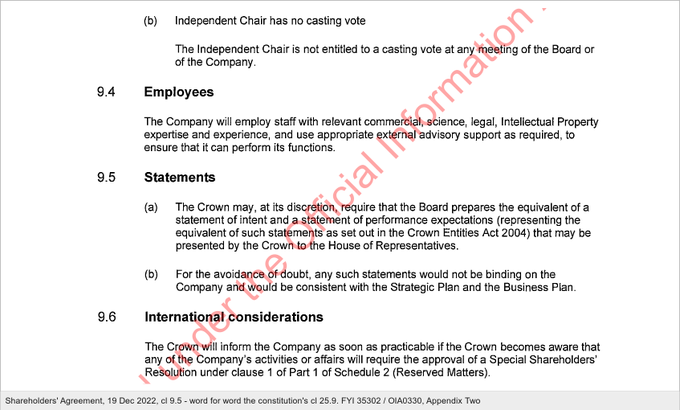
The Crown may require the statements. They may be presented to the House. They would not be binding on the company.
Three soft verbs in one clause. Every door is a door the Crown has to choose to walk through, leading to a document that obliges nobody.
Seven days after Cabinet was promised accountability consistent with the Crown Entities Act, the Crown signed clause 2.4(b).
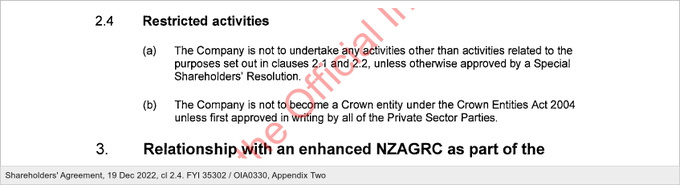
“The Company is not to become a Crown entity under the Crown Entities Act 2004 unless first approved in writing by all of the Private Sector Parties.”
The private partners hold a written veto over the thing Cabinet had been assured about the week before.
Never once
In August 2026 I asked the two Ministers through whom the Crown holds its shares, and the Treasury, a question with a one-word answer. Has clause 25.9 ever been used?
Treasury answered in October.
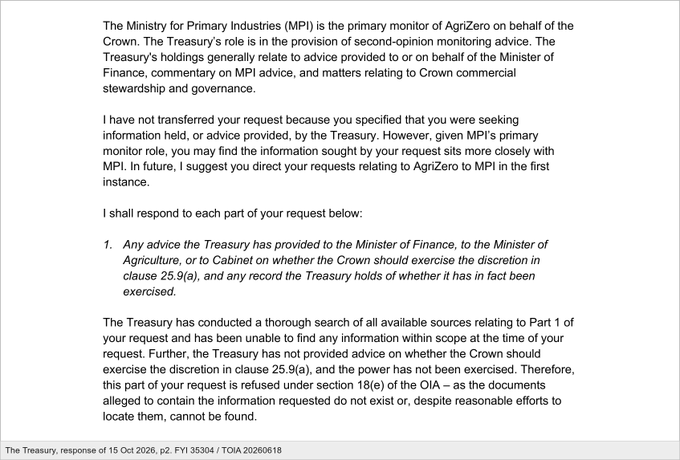
“The power has not been exercised.”
The Minister of Agriculture answered the same week.
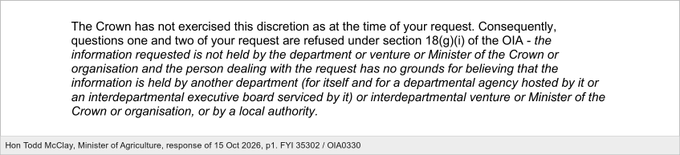
“The Crown has not exercised this discretion as at the time of your request.” And then the line that matters more: he has “not sought nor received advice concerning whether to exercise the discretion in clause 25.9(a).”
The Minister of Finance referred me to his answer.
The clause has existed since December 2022. Two governments. Nearly four years.
It has never been used. No Minister now holding those shares has asked whether to use it. Treasury has never offered a view.
The answer was not no.
There was never a question.
Now the uncomfortable part
The obvious version of this story is that a half-public company keeps its finances hidden. That version is wrong, and the truth is worse.
The Crown has full access, and it negotiated hard for it. Under the Shareholders’ Agreement, the company must hand every shareholder the audited financial report, the directors’ report and the auditor’s report within four months of year-end, prepared to the Auditor-General’s Auditing Standards by an auditor “approved by the Office of the Auditor-General.” Every shareholder has “access at all reasonable times to the books and records.” They may take copies. They may put questions directly to the auditor. If the Crown has genuine concerns about performance, it can commission its own review.
And the machinery runs. Here is the list of what the Minister of Agriculture has actually received.
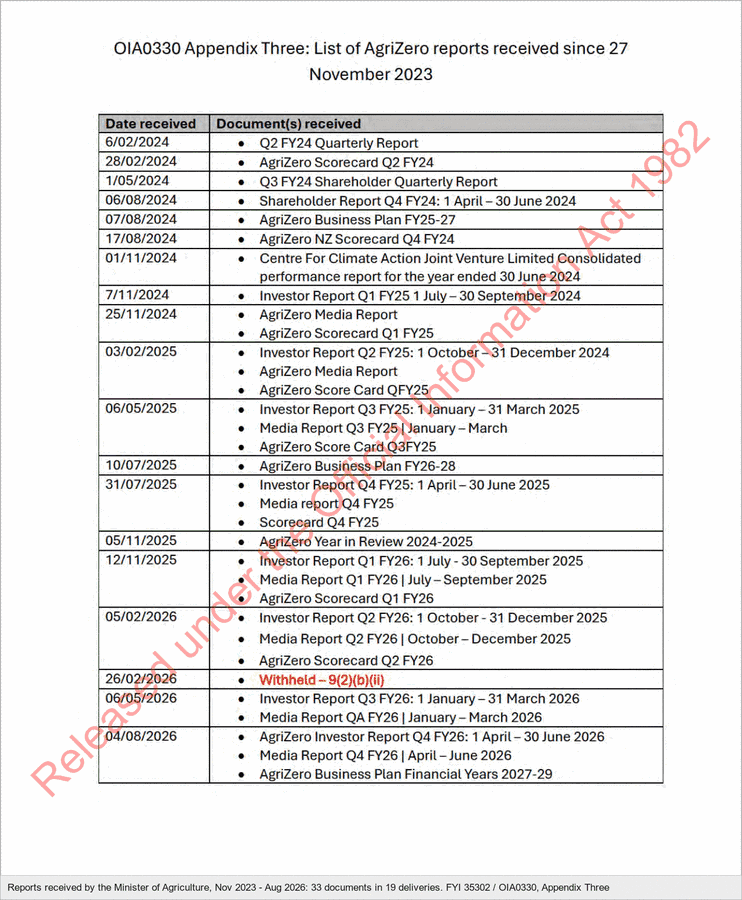
Thirty-three documents across nineteen deliveries. An investor report every single quarter. Scorecards. Media reports. Three successive business plans.
The Crown reads the books. It has read them every quarter for two and a half years.
Public audit standards. Private audience.
None of it has to be published. None of it is.
What the public gets instead is the Year in Review, which the company publishes because it feels like it, and which says on its own face that it “is not mandatory and is not completed in accordance with any applicable accounting or disclosure standards.”
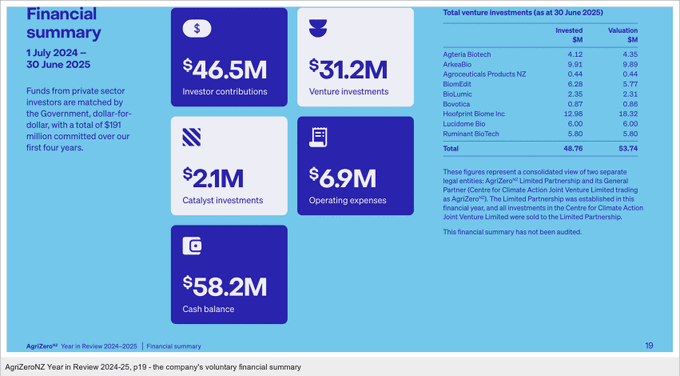
Down in the corner, under the numbers: “This financial summary has not been audited.”
That is the public’s view of a company it half owns.
Then the money moved
In mid-2024, the investments were transferred out of the company and into AgriZeroNZ Limited Partnership. MPI’s annual report is candid about why. The restructure “provides tax optimisation for private sector partners.”
Go and search the public register for that partnership. You will find one general partner and no limited partners at all. The Crown does not appear anywhere on it.
Be careful here, because this one is not what it looks like. That is not anybody hiding anything. It is section 115 of the Limited Partnerships Act 2008, which requires the Registrar to “treat limited partner information as confidential,” and then adds that “the Official Information Act 1982 does not apply to limited partner information.”
Parliament did that in 2008, and it is true of every limited partnership in the country.
But look at the effect. Moving the portfolio into a partnership took the Crown’s half off the public record and switched the OIA off over it, in one step, automatically. Nobody had to conceal anything. The statute does it by default.
Which brings us to the last document, and the only place in this whole file where two official statements cannot both be true.
Asked for the partnership agreement’s transparency provisions, the Minister of Agriculture said it “does not contain such clauses as requested,” and withheld it in full. Treasury withheld its copy too.
But his own briefing, released as Appendix One of the same response, records officials reviewing a draft in June 2024 and concluding that “the protections provided in the Shareholders Agreement have been fully incorporated and provided for in the limited partnership Agreement.”
Fully incorporated, or not there at all. Pick one.
If the protections travelled with the money, the stated ground for withholding does not describe the document. If they did not, the advice Ministers relied on at the moment of decision was wrong.
Either answer is worth having. Neither has been given.
Two levers, and nobody has touched either
The Crown can require those statements and lay them before the House whenever it likes. It never has, has never sought advice on doing so, and was never offered any.
Parliament can pull the company into the annual review regime by its own resolution. Standing Order 353 covers any “public organisation” the House resolves to be one. It has not done that either.
What Cabinet was promised in December 2022 was accountability consistent with the Public Finance Act and the Crown Entities Act. What got built was a set of private commercial information rights that work beautifully for the shareholder holding them, and exactly one discretionary bridge to Parliament, which nobody has crossed.
There are no apparent breaches of law here. But we may never know if it’s an economic failure.
The structure was chosen deliberately, over Treasury’s written advice. Treasury said at the time that it could not confirm the substitute was equivalent. The substitute turned out to be a discretion nobody has ever exercised. And the one document that would settle whether any of it survived the restructure has been withheld in full by both holders.
Four years. Around $154 million. A company that half belongs to the public.
The Crown wrote itself the right to put that company in front of Parliament, and in four years has never once picked it up.
Somebody should ask why.
Sources
OIA responses of October 2026, public at fyi.org.nz – FYI 35302 (Minister of Agriculture, OIA0330, including the Shareholders’ Agreement and the briefings); FYI 35304 (Treasury, TOIA 20260618, including Treasury report T2022/1688); FYI 35303 (Minister of Finance; the reply carries no agency reference); FYI 34180 (MPI, OIA26-0225). Constitution and share register, Companies Register 8567966; partnership 50213461. MPI Annual Report 2024/25. Estimates 2026/27, Vote Agriculture, Biosecurity, Fisheries and Food Safety. The $117 million round is the company’s own announcement of 5 October 2026; the Crown’s share of it rests on the company’s dollar-for-dollar statement, not a government figure.
Auth by A Riley for Sovereign, [email protected]
Originally published on VoteSovereign on X.
Our Contributor
