
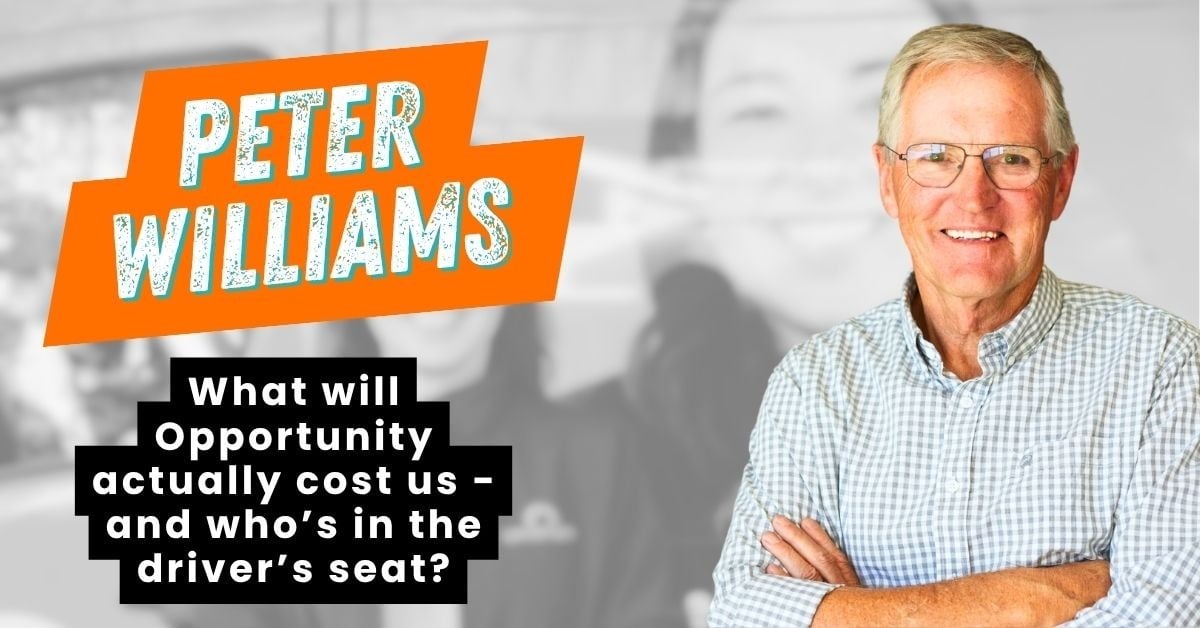
by Peter Williams
There’s a new political party that’s beginning to look increasingly likely to make it into Parliament after the November election.
Opportunity has regularly broken through the five-percent barrier in recent opinion polls.
Roy Morgan has it on 8%. The latest Taxpayers' Union–Curia poll has it on 6.1%. 1 News has it also at 8%.
And that means we need to start taking Opportunity seriously.
Not necessarily because its policies are good.
But because it may soon have enough MPs to matter.
And there is a lot about Opportunity that voters need to understand before they give it their party vote.
Its tax policy is perhaps the most obvious example.
Opportunity wants a fundamental restructuring of New Zealand's tax system, including a land-value tax and a Citizens' Income. Its own transition plan says the land-value tax would initially be 0.5% on urban land, eventually forming part of a much larger tax reset.
That is a very different proposition from simply taxing income.
And it raises a very obvious question.
What happens to the New Zealander who owns a valuable piece of land but doesn't have a large income?
Think about an older couple who have lived in the same house for forty or fifty years. Their home may be worth a million dollars or more, but they may have very little disposable income.
A tax on the value of their land doesn't care whether they have the cash to pay it.
Opportunity can talk about deferrals and transitional arrangements, but eventually somebody has to pay.
And for many older property owners, that could mean the tax accumulating against the family home until it is eventually sold or becomes part of the estate.
In other words, what begins as a land tax can start to look remarkably like an inheritance tax.
But the tax policy isn't actually the most interesting thing about Opportunity.
The really interesting issue is who runs the party.
The party has been badly exposed in recent days over its constitution and the power it gives its board.
Opportunity says it wants a new kind of politics — one based on honesty, evidence and transparency.
Fine.
But if Opportunity gets into Parliament, voters deserve to know exactly where the ultimate authority lies.
Is it with the elected parliamentary caucus?
Or is it with the party board?
That matters enormously if Opportunity becomes a potential coalition partner.
Because imagine the election result produces a Labour government that needs Opportunity's votes to govern.
Who negotiates?
Who decides what Opportunity will accept?
And who has the final authority to approve the deal?
Those aren't constitutional technicalities.
They go to the heart of parliamentary democracy.
And then we come to Alan Wilderland.
Wilderland is a successful businessman, a founder of Serato and a member of the Opportunity board.
He is also by a very considerable margin the party's biggest individual financial backer.
Electoral Commission records show him making three donations totalling $230,000 at the end of June alone — $80,000, $75,000 and $75,000 — followed by another $25,000 donation.
So we are talking about a quarter of a million dollars in publicly disclosed donations to Opportunity in 2026.
Now, there is nothing illegal about that.
And Wilderland is perfectly entitled to spend his money supporting a political party whose philosophy he believes in.
But let's not pretend that money doesn't buy influence in politics.
Wilderland himself has cheerfully acknowledged that he belongs to the one percent of New Zealand's wealthiest people.
And here is where the irony becomes rather difficult to ignore.
Opportunity wants to restrict political donations to $30,000.
Yet one of its own board members has personally contributed more than eight times that amount to the party this year.
His argument is essentially that you have to pay to get into the political game and then you can change the rules.
Well, perhaps.
But voters are entitled to ask another question.
How much influence does a quarter of a million dollars buy when the donor is also sitting on the party board?
I am not suggesting that Wilderland secretly runs Opportunity.
I don't know that he does.
But the structure of the party makes the question legitimate.
And it becomes even more interesting when you consider the type of voter Opportunity appears to be attracting.
It is not primarily the traditional working-class protest vote.
It is the younger, well-educated, relatively affluent, socially progressive New Zealander — the sort of voter you find in suburbs such as Grey Lynn, Thorndon and Merivale.
In that respect, Opportunity looks rather like the Green Party did in its earlier years: highly educated, idealistic, environmentally conscious and convinced that the economic system needs a fundamental reset.
And perhaps that's why Qiulae Wong is so important to the party's prospects.
She is young, articulate, highly presentable and extremely effective on television.
The recent Q+A appearance may have exposed weaknesses in the party's constitutional arrangements and tax policies.
But Wong herself remains a formidable political communicator.
And that may be enough to keep Opportunity above five percent.
Which brings us to the real danger for the parties of the centre-right.
They should not simply attack Opportunity's voters.
They need to win them back.
And the message should not be that people shouldn't care about inequality, the environment or poverty.
Of course they should.
The argument needs to be about how you actually make people's lives better.
You don't make a country prosperous by endlessly redistributing a pie that isn't growing.
You make it prosperous by growing the pie.
By encouraging investment.
By rewarding enterprise.
By increasing productivity.
By creating businesses that employ people at higher wages.
And by giving people at the bottom of the economic ladder the opportunity to move up — not simply by handing them larger cheques funded by somebody else.
That is the economic argument the centre-right needs to make, particularly to the young, affluent and educated voters who are attracted to Opportunity.
Because Opportunity is offering them something very seductive:
A political system in which inequality can be reduced by taking more from those who have more.
But the hard truth is that taxing your way to prosperity doesn't work.
If Opportunity does get into Parliament, it may have considerable influence over the next Government.
And if that Government is Labour, the pressure for a much more redistributive economic programme will be substantial.
So don't dismiss Opportunity.
Don't laugh at it.
Don't assume it will disappear.
Take it seriously.
Because the polls suggest it may be here to stay.
And if it is, New Zealand voters need to ask two very simple questions before November:
What will Opportunity actually cost us?
And perhaps even more importantly:
Who will actually be making those decisions?
Listen to the full episode on RCR.
Our Contributor

Excellent commentary Peter which will certainly help clear up some of the confusion about this new political party.
Apart from the younger group of voters you have identified that might vote this way I believe Opportunity will also pick up the votes of people who are sick and tired of the performance of our established parties and in some ways I liken it to the same thinking by many voters back in 1993 when by binding referendum they called for something better and got MMP introduced. Whether that was a good thing remains debatable!