
by RCR Reporters
RCR EXCLUSIVE: New vaccination data obtained by RCR, alongside emails released earlier this year, reveal that 311,257 teenagers received a second dose of the Covid vaccine after officials and Vaccine Ministers had been advised of the increased risk of myocarditis following a second dose in young people.
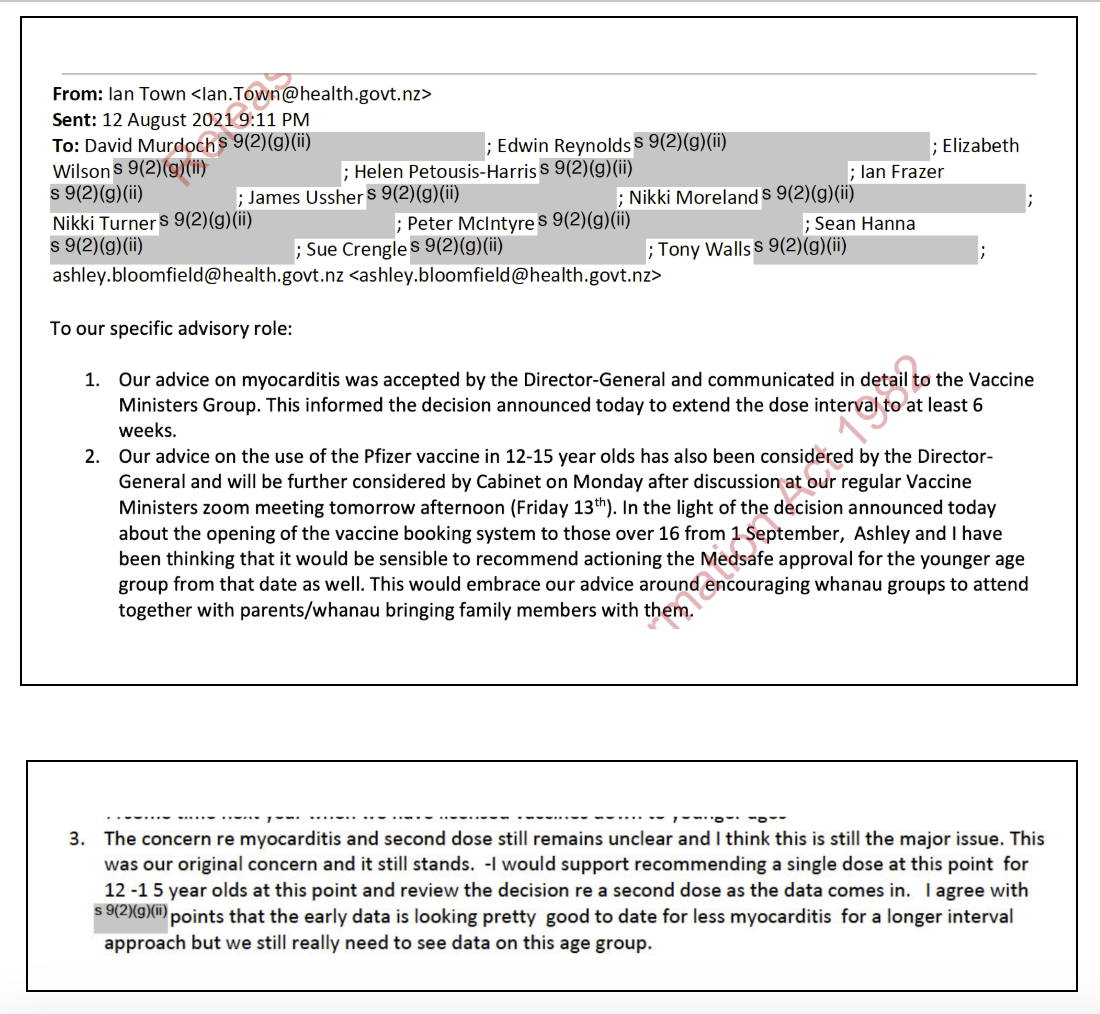
An email from Dr Ian Town, the Covid-19 Vaccine Technical Advisory Group (CV TAG) chair, dated 12 August 2021, shows the group's advice on myocarditis risk and the recommended dosing schedule for 12 to 17-year-olds had been accepted by Director-General of Health Ashley Bloomfield and communicated “in detail” to the Vaccine Ministerial Group.
The ‘Vaccine Ministers’ was an informal group with no terms of reference that was set up to help govern the management of New Zealand’s portfolio of Covid-19 vaccines, including the immunisation programme rollout. Cabinet delegated decision-making authority to the Vaccine Ministers on certain aspects of the Covid-19 Immunisation Programme. Members were Chris Hipkins, Minister for Covid-19 Response and chair of the group; Prime Minister Jacinda Ardern; Finance Minister Grant Robertson; Health Minister Andrew Little; and Associate Health Ministers Dr Ayesha Verrall, Aupito William Sio and Peeni Henare.
The new data, along with the emails, helps join the dots about who knew what, when, and reveals the extraordinary scale of the teen population that subsequently received two doses.
Additionally, OIA documents obtained and reported on over several years, including in The People's Position, The People's Report and RCR's myocarditis timeline, have documented discussions among CV TAG about myocarditis and pericarditis – including the elevated risk following a second dose, alongside consideration of vaccination schedules for young people.
What happened to the public messaging?
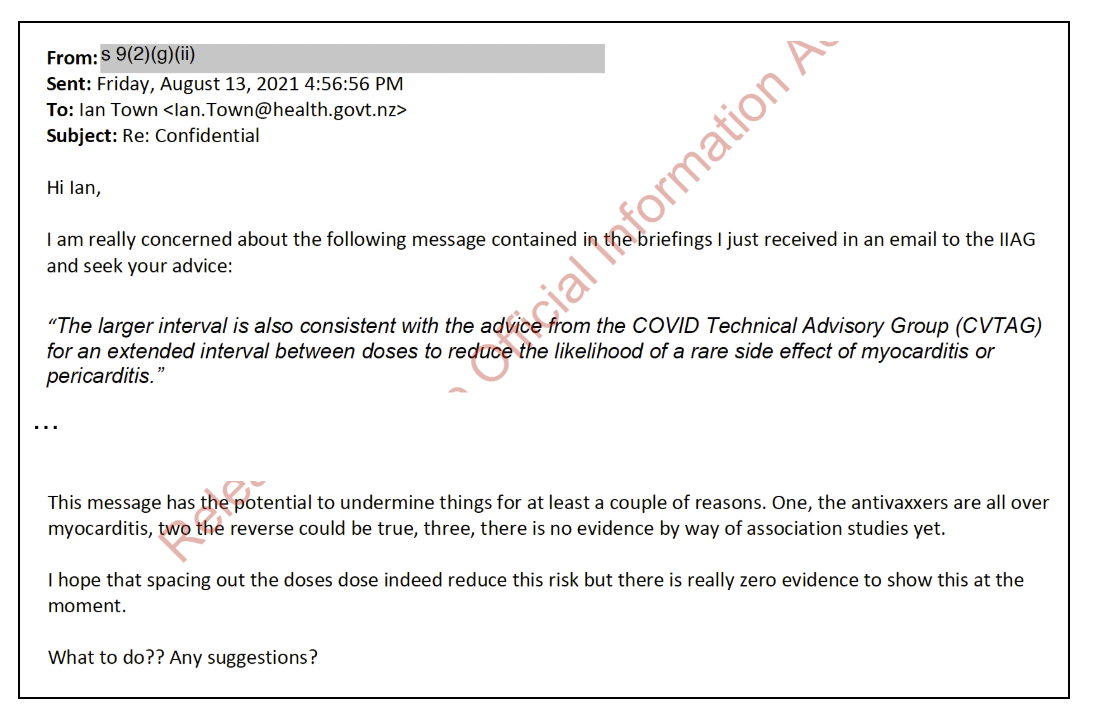
One day after the Vaccine Ministers had been advised of the risk, public messaging explaining that the dosing interval was being extended from three to six weeks due to the risk of myocarditis, was rapidly withdrawn and redrafted to exclude the reasoning.
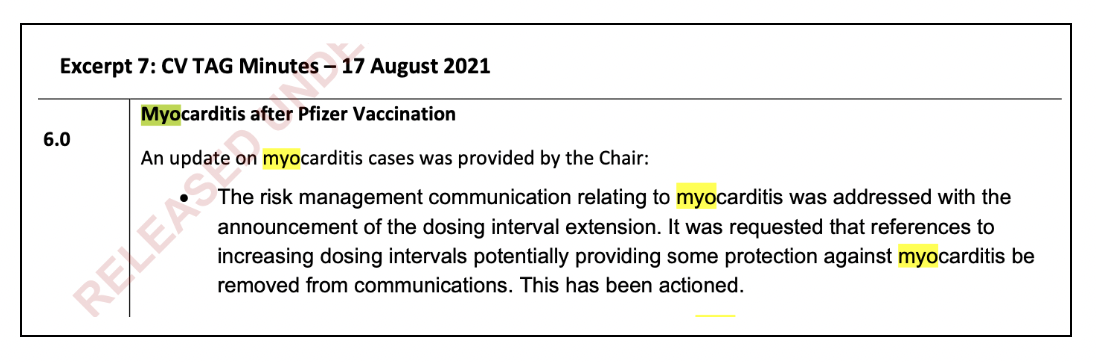
An email on 13 August to Ian Town from an unidentified official whose name was redacted, stated:
“This message has the potential to undermine things for at least a couple of reasons. One, the antivaxxers are all over myocarditis, two the reverse could be true, three, there is no evidence by way of association studies yet.”
Combined with information previously released, the exchange raises serious questions about the lack of transparency and informed consent being afforded to the public as the teenage vaccination programme expanded.
Two shots for summer
The rollout to healthy 12 to 15-year-olds began on 1 September 2021.
Over the following months, the Government launched its highly visible Two Shots for Summer campaign and introduced mandates and vaccine passes.
For teenagers, two doses increasingly determined access to parts of ordinary social life, including hospitality, concerts, festivals and other venues requiring vaccine certificates.
Meanwhile, the Government's own advisers continued discussing the implications of the second dose for younger people.
In November, CV TAG again noted that younger age groups were at greater risk of myocarditis following a second Pfizer dose and raised concerns about requiring two doses under vaccine mandates. It recommended consideration be given to allowing younger people subject to work mandates to be treated as ‘fully vaccinated’ after one dose.
On 9 December, CV TAG again raised concerns that its earlier advice supporting a single-dose approach for 12 to 15-year-olds had not been reflected in the Government’s definition of ‘fully vaccinated’.
Meanwhile, tens of thousands of teenagers had been receiving second doses.
The important number isn't 90,000
Recent media reporting has focused on approximately 90,000 young people who had not received two doses when officials were considering whether younger people should require a second dose.
By that point, 311,257 12 to 17-year-olds had already received dose two.
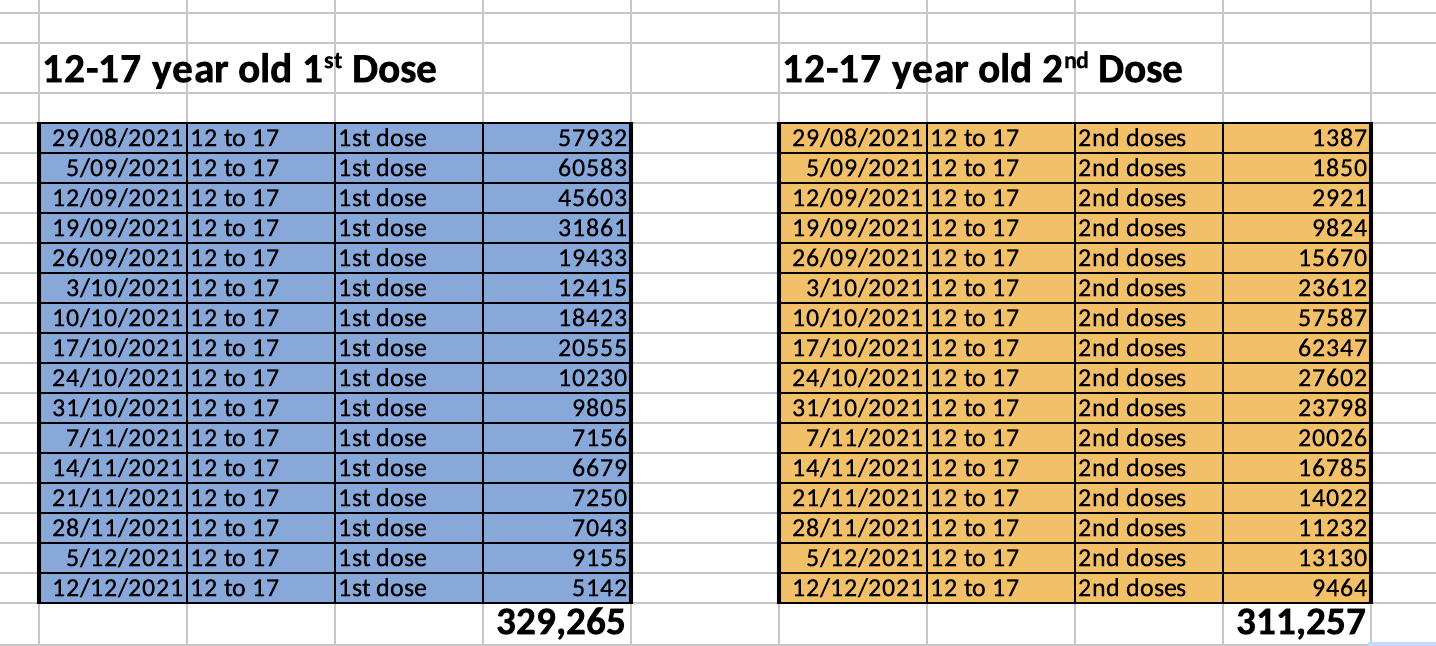
Data source: Health NZ
On 15 December, following the vaccine-related myocarditis death of 26-year-old Rory Nairn, Bloomfield wrote to health providers directing that information about myocarditis and pericarditis be provided both verbally and in writing “to every consumer” as part of the vaccination and consent process.
In 2021, there were around 400,000 12 to 17-year-olds in New Zealand, meaning approximately 78% of the entire age group had already received their second dose.
Focusing on the 90,000 who remained outside the two-dose group therefore risks obscuring the much bigger picture: the overwhelming majority of New Zealand teenagers had already gone through the two-dose programme.
RCR co-founder Alia Bland said the figures raised fundamental questions about informed consent.
“You cannot have informed consent without honesty. Parents and young people had a right to know what was known, what remained uncertain, and what the Government's own experts were concerned about. You don't get to decide which information people can handle and still call their decision informed.”
Katie Ashby-Koppens, Head of Legal at VFF, said the figures demanded action.
“Every one of those young people should now be offered a cardiology consultation and appropriate testing, at no cost to them or their families,” she said. “Parents made decisions for their children based on the information they were given at the time. The least the Government can do now is ensure those young people have access to proper cardiac assessment.”
Watch and share Alia Bland and Katie Ashby-Koppens' discussion of the newly released vaccination data.
Read more about the evidence and events surrounding the Covid-19 response in The People's Position and The People's Report, and see RCR's updated myocarditis timeline.
Our Contributor

The fiendish 5 need to be held to account.JA CH AB GR AV evil to the extreme.
In October 2021 Hipkins mandated Education Workers as young as 12 to have two doses of the vaccine 6 weeks apart. The real scandal, however, is that Drs Bloomfield and Town were ‘Expert Witnesses' for Hipkins in the Teachers Court case in early 2022, and both clearly knew of the advice that had been given about myocarditis, yet neither informed the High Court of this in their expert testimony. In withholding this highly relevant information from the court, they likely breached the High Court rules for expert witnesses … (expert witnesses basically swear affidavits to be impartial advocates for the court)!
Thank you for your work to keep this question alive. How will parents of injured teenagers be heard if these questions are not asked.
Yet no one will be held accountable as per usual.
So, when will these vile perpetrators be held accountable by the government? They could ask the courts to reconvene with the knowledge of knowing the perpetrators knew the sickening evidence in front of them. Saying it was not yet proven is not a defence.
What are the up to date figures of sudden cardiac deaths? Or unexpected deaths occurrence?
Because of their despicable behaviour 100’s of thousands are put in a position nobody would want.
I'll never forget Hipkins threat when asked about those who refused to take the JAB… “We will hunt them down.”
The war against vaccine hesitancy was so intense, that they decided to shut up about any known risk, because that would have signalled there might be something wrong with the vax. This in turn would have opened up the conversation on risk – ultimately, legitimising hesitancy. Hesitant people needed to all be “selfish cookers” in the public eye, if you remember. So, they basically chose to sacrifice the young. Now they're playing to waiting and deferring game…in a few more years, complainers will be told “too long ago to worry about now – move on”. That's what our politicians are waiting for. The long game will probably win them peace and evasion from accountability, in time. Ps. Yes, of course, they should all be rotting in prison.