

by CIG
Harold Mackinder wrote in 1904 that the era of European maritime predominance established 400 years earlier was coming to an end. Western naval and colonial powers had previously been able to outflank and dominate the Asian landmass through superior technology. But the consolidation of great continental-sized land powers such as the Russian Federation and potentially China—combined with changes in land transportation—meant that insular maritime democracies including Great Britain would have a more difficult time maintaining their global position. Mackinder asked his readers to envision continental Europe, continental Asia, and continental Africa as a single “World Island,” possessing most of the world’s population and industrial potential.
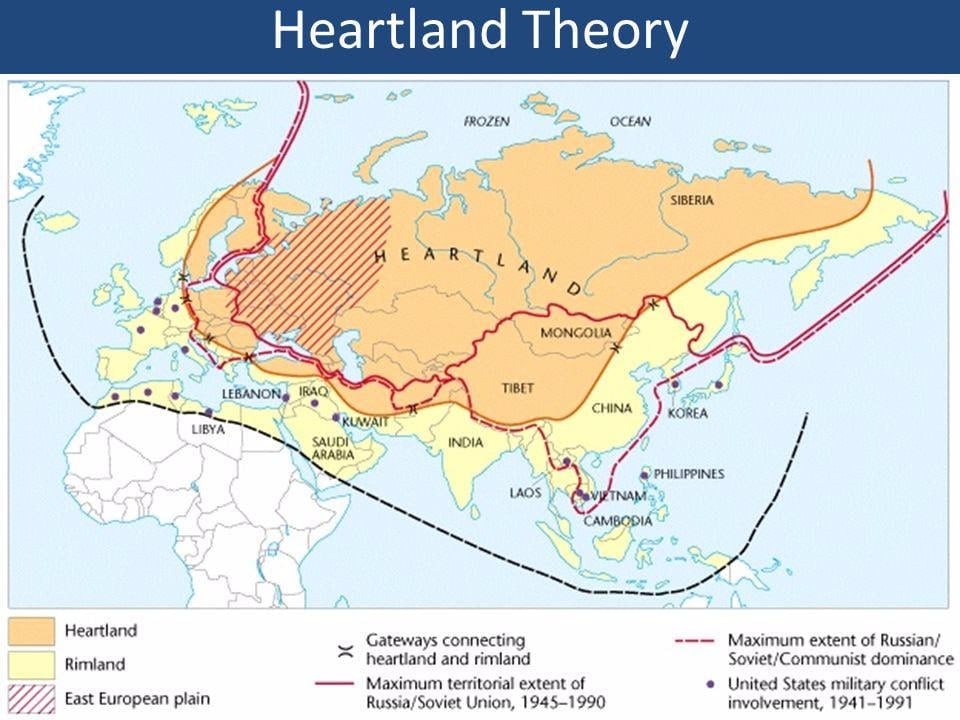
The core of this world island he called the Heartland, inaccessible to sea power—essentially, Russia, Mongolia, Tibet, and Central Asia, including parts of China and Iran. If the world island were ever united under a single political entity, with a base in the Heartland, then it would possess overwhelming economic and military advantages over the outer crescent of geographically insular maritime powers, such as Great Britain, Japan, and the United States. Mackinder’s recommendation was for these maritime powers to encourage the creation of geopolitical buffer zones, for example in Eastern Europe.
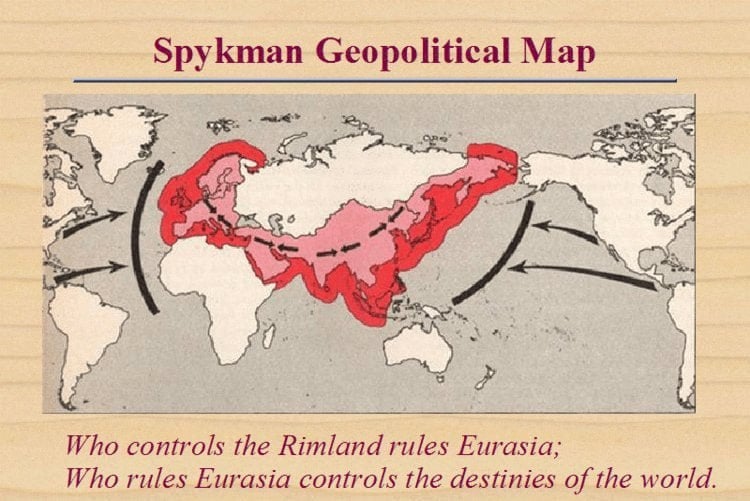
Writing in the early 1940s, Nicolas Spykman modified Mackinder’s formulations by pointing to the existence of what he called an amphibious Rimland—located in between the Heartland and its great offshore islands—and stretching from Western Europe around the Middle East, across India, ending in coastal China. Spykman pointed out that most of the world’s productive potential was in the Rimland, not within the Heartland. Control of the Rimland therefore meant control of the world—precisely what was at stake during both world wars—and this would be determined by struggles between mixed alliances, rather than by simply lining up sea powers versus land powers straightforwardly.
If the U.S. failed to maintain control over vital sea and airspace in the Atlantic and Pacific Oceans, then some other power eventually would. Even a predominant U.S. influence in South America’s southern cone could hardly be taken for granted, given the vast distances involved, and if that influence were lost then a hemispheric defense would collapse into something more constrained and impoverished. Taken as a whole, the Rimland’s economic and military weight pointed to no secure resting place for Americans in the absence of internal Old World balances, and these balances would have to be actively upheld by the United States. As he put it, America’s “main political objective, both in peace and in war, must therefore be to prevent the unification of the Old World centers of power in a coalition hostile to her own interests.”
What is the geopolitical situation in our own time? Since the 1990s, there clearly have been some very significant shifts within the international balance of power, in broad alignment with Mackinder’s predictions over a century ago. The single greatest gravitational shift in relative economic and military weight has been from the Atlantic toward the Pacific, and from Europe toward Asia. The Indo-Pacific, rather than Europe’s Western half, is the focus of the world’s greatest economies, militaries, and geopolitical ambitions. In particular, the dramatic long-term growth in China’s economic capabilities allows it to build greater diplomatic and military assets.
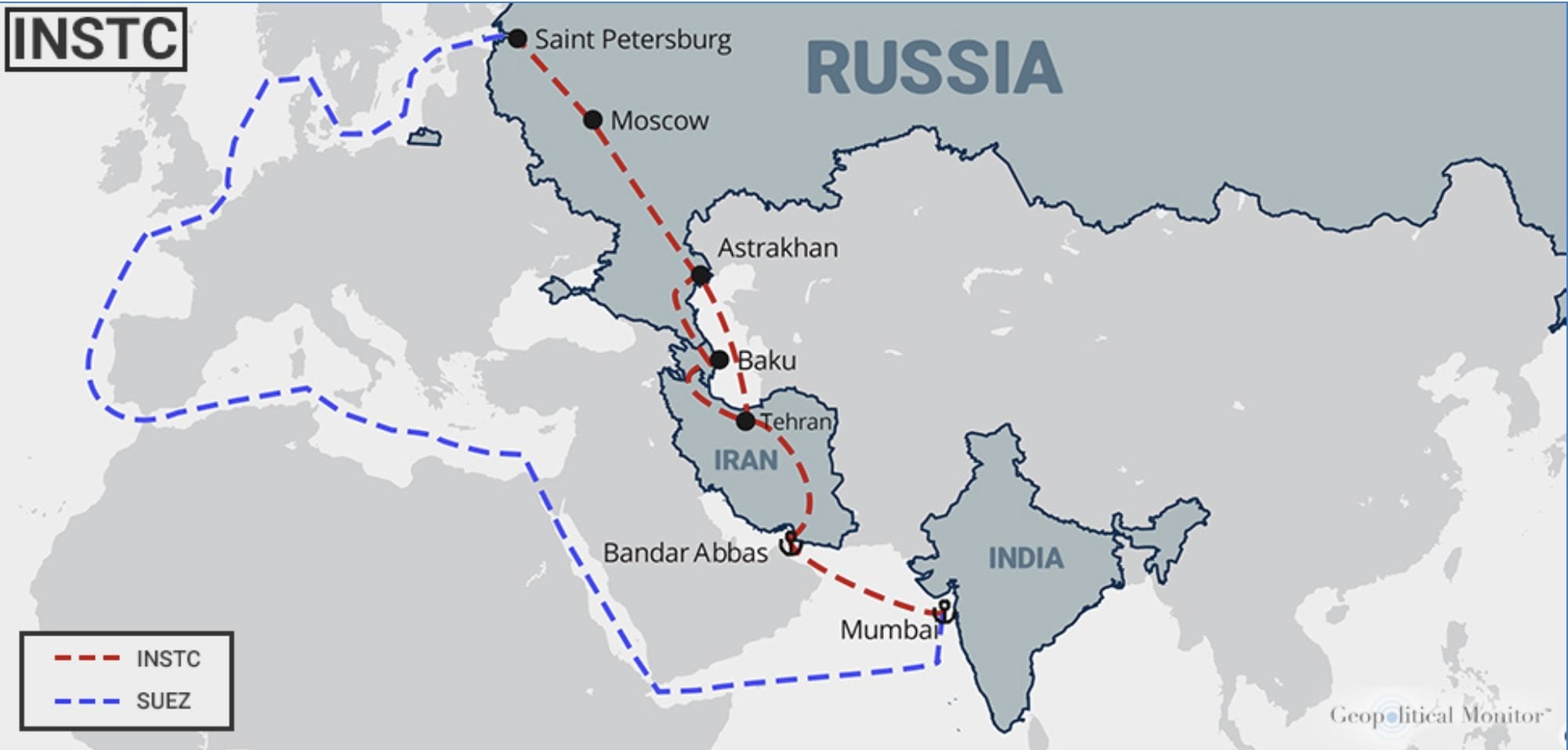
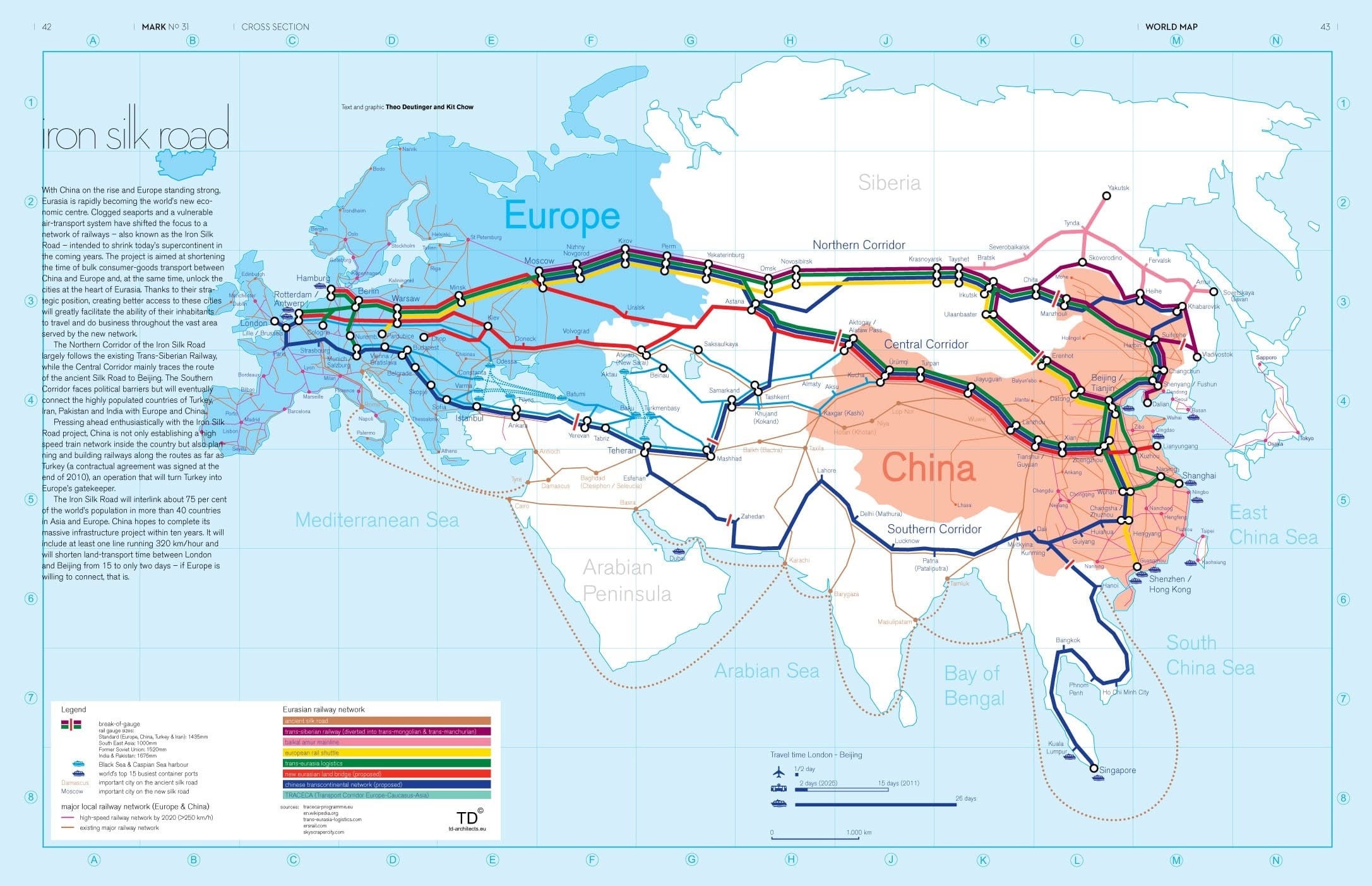
The blockade of Iran will accelerate the development of the railway network in Central Asia linking Iran to China's industrial base. While the railways will not be able to replace maritime trade, once the U.S. lifts the blockade, they will reinforce the Iranian economy and tighten China's grip over the economies of the region. This is just one of the many ways the 3rd Gulf War backfired.
Originally published on Counter Intelligence Global on Telegram.
Our Contributor
