by Maree Buscke
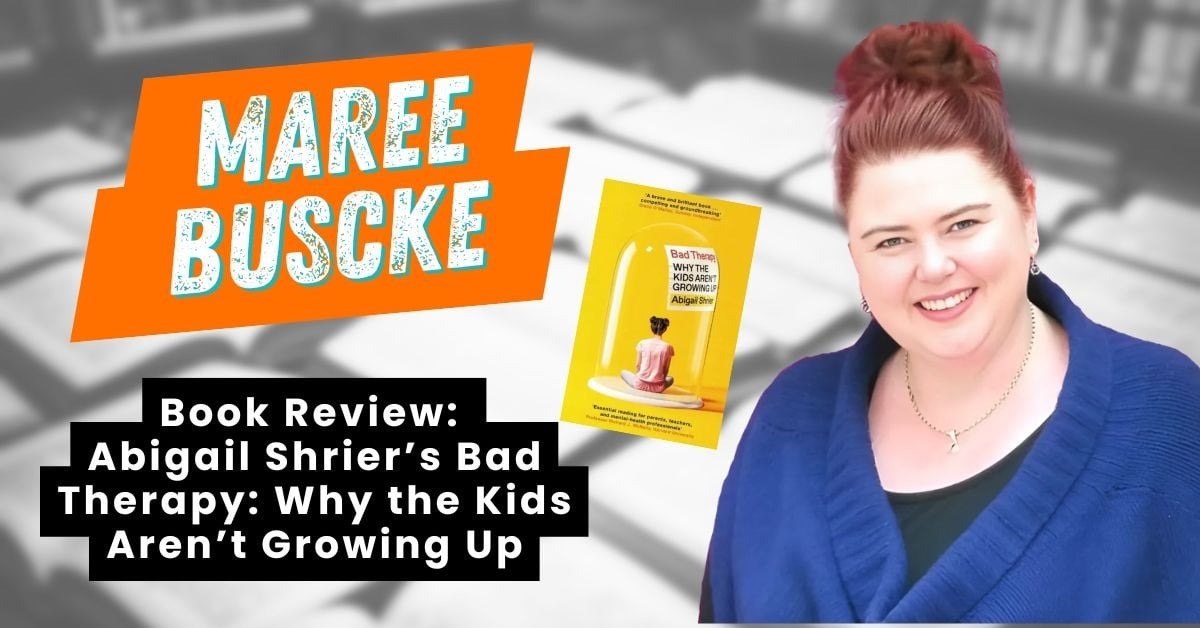
Abigail Shrier’s Bad Therapy: Why the Kids Aren’t Growing Up takes a swipe at how therapy culture has become part of everyday life for children, parents, and schools – especially in the United States. Shrier is a parent of school aged children, she’s a busy working Mum and this book was sparked by a personal experience at her child's school and a survey she was asked to take. The framing and questions asked appalled her and forced her to take a closer look at what was going on. This is hardly surprising, especially as her previous book, Irreversible Damage, looked at the social contagion of Trans among young school aged girls, she had already intersected with how ideologically driven school based counselling could be, so she was naturally on high alert.
One of the things that stands out about this book, just as it did with its predecessor, is how much research she pulls together. Shrier draws on interviews, studies, and real-life examples from families and schools to build her case. It feels well-researched in the sense that she’s clearly spent time gathering different perspectives and data, even though she’s guiding it all toward a particular point of view. One that is carefully argued meticulously researched.
The main theme in the book is what she describes as “overparenting.” She suggests that a lot of parents today are more involved in their kids’ emotional lives than in the past, often stepping in too quickly when something feels difficult or uncomfortable. Essentially parents have all these so-called solutions in front of them in the form of therapy, medication or other interventions and all they need is the suitable symptom to match. From her perspective, this comes from a kind place, wanting to support their children, but it can sometimes mean children simply don’t get the time or the space to work things out on their own. She raises the question of whether constantly managing children's feelings might make it harder for them to build confidence and independence over time and not allowing children to develop their own risk muscles and in effect stunting their ability to lead confident happy lives.
Shrier also spends quite a bit of time talking about schools and how their role has changed. She points out that schools are doing more than just focussing on academics, they’re also focusing on students’ emotional wellbeing, through things like counselling and social-emotional learning programs. In her view, this can sometimes blur the line between what schools do and what families handle at home. She’s concerned that schools can end up stepping into areas that used to be more clearly part of the parent-child relationship. This aspect of the book is obviously very US centric, but here too in New Zealand there is a growing trend of state based interventions into how we parent all wrapped up in the guise of ‘safety’, as a parent who raised a son which required assistance for many of the conditions covered in Bad Therapy, trying to navigate the line between getting the right help and still being able to parent as you see fit, is challenging and requires fortitude.
A contentious part of the book is how she connects all of this to rising levels of anxiety and stress among young people. She suggests that some of the well-meaning support systems might actually be having unintended effects. She openly challenges new parenting norms, personally I loved what she had to say, but then I am a Gen X parent, my husband and I took a more liberal approach to parenting than our Millennial compatriots, our sons had more autonomy, were expected to do more around the house and they weren’t plastered with every activity under the sun to keep them occupied. I read many parenting books during the times the boys were young, especially our neuro-divergent number one and I have to say if Bad Therapy was around a decade ago I would have approached a few things a little differently.
Overall, Bad Therapy comes across as a thoughtful, well researched and very personal take on modern parenting and education. It’s grounded in research, but it’s also trying to make a clear argument. Even if you don’t agree with everything Shrier says, it’s the kind of book that gets you thinking about how much support is helpful, but more importantly – what is harmful, and how no two parenting experiences are the same. I liked Shriers conclusions on the pure joy that parenting can bring, especially if you let your own neuroses go and just allow the chaos of parenting wash over you. Take it from me, you might be surprised at how well things work out.
Abigail Shrier’s Bad Therapy: Why the Kids Aren’t Growing Up – available now at all major book resellers.
Our Contributor
