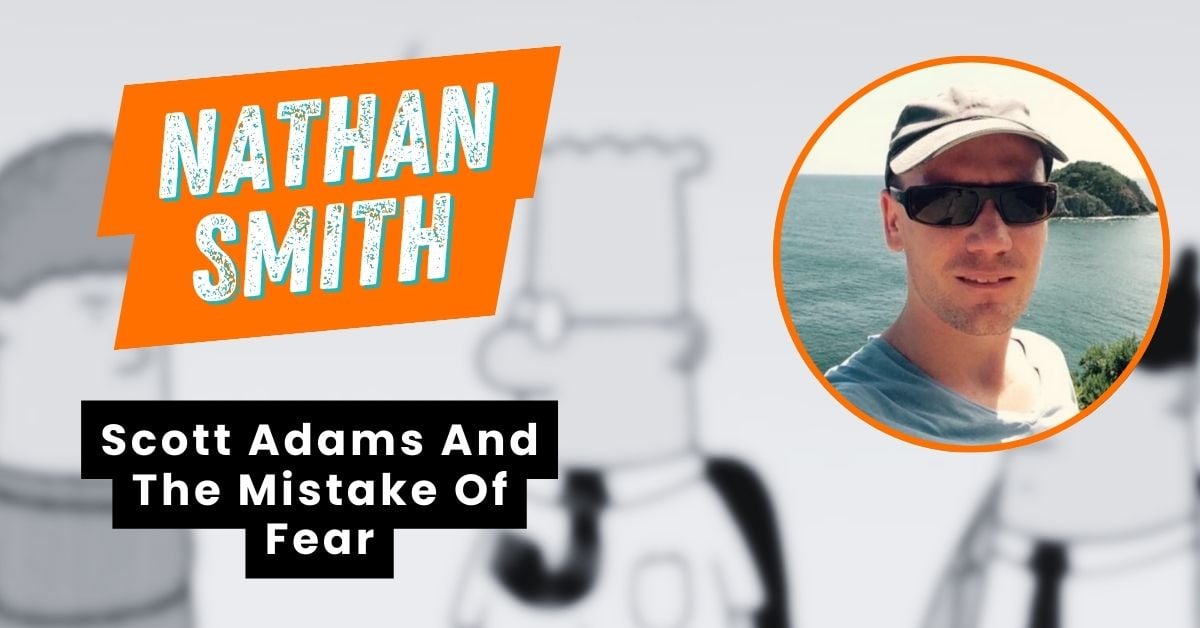
by Nathan Smith
The American cartoonist Scott Adams died last week at the age of 68. When he was correct, he was useful. But when he was wrong, it was because he was scared. And fear is not a good basis for decision-making.
After jumping between white-collar jobs for the first chunk of his life, Adams eventually grew disillusioned with the corporate world and began drawing cartoons lampooning the absurdity of office life. Adams’ goal was to feed back to corporate managers their own tired tricks, tribulations, and foibles. In a short while, his popular cartoons were happily syndicated by newspapers across the US.
But the Dilbert author didn’t become a cultural force until he rebranded during the lead-up to Donald Trump’s first presidency. Because Adams was a “trained hypnotist,” he quickly noticed Trump’s high-level persuasion techniques and realised the election was pretty much over for Hillary Clinton. He began to explain what Trump was doing, breaking down the techniques in ways normal people could understand.
I remember tuning in every other day or trying to catch clips of his talks because he would often accurately predict what was going to happen. For a journalist, that was extremely useful. In fact, one of his most important lessons was that if a person can predict the future, then their model of the world is accurate. Bad prediction? Time to update your model. Good prediction? Time to figure out why it worked so well.
Adams correctly predicted Trump’s victory with “99%” certainty months out from the 2016 election date. He was correct. Then more people started listening to Adams. Soon, he had a large following, and his lessons were reaching a wide audience. Adams then began to analyse daily news stories, trends and the larger narratives. He tackled climate change, China, the opioid epidemic, crime statistics, Democrats vs Republicans, explaining his thinking process to millions of viewers. The audience felt lucky to watch a master unpack and update his model of the world in real-time.
But then Covid happened.
As expected, Adams applied his process to figure out what was really going on. Fast-forwarding a bit, he eventually concluded that the risk of damage from Covid outweighed the risks of an untested vaccine, and so he announced in a livestream that he would take the jab. Although he never suggested that others follow his lead, the persuasion expert knew exactly what he was doing when he yelled at anyone who said he should be a bit more sceptical about the Covid vaccination.
But I had started to notice that Adams’ conclusions often seemed influenced by fear. His decision to support Republicans (as a lifelong Democrat) was based on the fear of what leftists might do to him for supporting Trump. He investigated climate change because he was afraid of what would happen to his assets if the narrative were true. He attacked China for its role in the opioid epidemic because his stepson overdosed and died from taking fentanyl. And he took the Covid vaccine out of fear.
I worried that he wasn’t being as objective as people assumed. Just like the rest of us, Adams started from the emotion of fear, and extrapolated that to its inevitable conclusion, covering up this subjectivity with the scaffolding of smart processes that made it appear he was being objective. He was no longer persuasive to me.
His fear-based thinking blew up publicly during the 2020-era Black Lives Matter shenanigans. Following months of petulant agitation by black groups across the world, in the middle of a so-called pandemic, Adams decided enough was enough. On another livestream, he advised that everyone “just get away from black people” because the relations between blacks and “whites” could never be fixed.
Of course, the mainstream media grabbed these soundbites and used them to paint Adams as a racist. Apparently, being a racist in the US is the Worst Possible ThingTM and all the newspapers that were carrying his Dilbert cartoons announced they would no longer do so. Adams was astounded at the insanity of these coordinated cancellations.
But the system’s immune response wasn’t insanity. While he appeared to be protecting “white” people, his position was coming from the negative. Adams thought he was telling the truth, but he was only expressing his fears of black people. The system recognised his negative energy and kicked him out of polite society. At that point, Adams should have followed his own advice and figured out why the system responded like that so he could update his model of how the world works. But he never did.
If he had asked why he was attacked, while the BLM rioters were coddled, Adams might have discovered that the multicultural system does have an internal logic to it. Sure, it’s a Mephistophelian logic, but it is logical, nevertheless. And knowing this logic would have helped him predict the future with greater certainty. But he never asked.
Here’s how the logic plays out in the everyday world. In the interests of civil harmony, the system does not care if a person spends their energy supporting their own ethnic or racial group. BLM was pro-black people, and because of this positivity, it received implicit backing from the system. Even today in Minnesota, there is a vast social welfare scam being committed by Somalians. Another massive welfare scam has been set up by Jews in New York. The truth is that the system does not care about these scams, precisely because the Somalians and Jews are scamming to support their own people in a multicultural society. This distinction makes all the difference.
In other words, the Somalians in Minnesota and the Jews in New York are practising a form of positive racism. I like to call this racialism. It could be true that many of those Somalis and Jews hate or fear other groups. They are, after all, just humans. But it is important, from the system’s perspective, that their motivating energy comes from a place of love for their own. The logic is simple: if every group spends all its time loving its own members first, there will be no time left for hating other groups.
Since the energy of Adams’ advice to “just get away from black people” came from his fear of black people, not out of love for “white” people, the system displayed an immune response as though he were a virus. If Adams had instead spent all his energy building communities or social networks for “white” people, he might even have secured a government grant, just like the Somalis and Jews!
“But the system hates white people!” That’s where you’re wrong. Do you think the Somalis in Minnesota, or the Jews in New York, got their money by saying: This will be used to help only our people? Of course not. They applied for grants by ticking the normal boxes and making it appear that their groups were worthy of taxpayer assistance. The system clicked into gear because is recognised that there was no fear or hatred involved, just Somalis and Jews loving their own people first. This distinction made all the difference.
Adams’ biggest mistake was that he never really cared about “white” people as a group. All he wanted was for them to get away from black people. That’s it. Not for “white” people to take care of each other. Not for “white” people to create a safe neighbourhood for themselves. Not to “white” people to take their own side in politics. His energy was always fear-based, and that’s why the system felt justified in rejecting him.
Adams’ fear also led him to make the wrong decision about Covid vaccinations. When he eventually apologised for supporting the vaccination, he said that distrusting the government was always the right decision, but he let his fear get in the way of making that conclusion. Adams had another chance to update his model of the world, but he never did.
I get it, all fears are variations on the fear of death. Many human behaviours stem from our inability to comprehend that we are finite creatures. Taking pictures? Remember me. Posting on social media? Remember me. Making children? Remember me. It’s all fear. “I will die. I must do something.”
But fear is never a good way to make decisions. Fear betrays the rabbit to the owl. Fear does the hard work, making the owl’s job easier. Fear clouds the mind until you can’t see that all your actions are negative, not positive. And eventually, people will start to smell your fear like a horrid body odour.
Fear is like guilt: it is just an emotion. You can, and must, think without fear. If you learn how to do this, I think Scott Adams would, ironically, be proud that his negative example turned out to be helpful in the end.
RIP
Originally published on The Good Oil.
Our Contributor
