Get The Digital ID RESIST KIT
Join the tens of thousands of Aussies learning how to reject the Digital ID control grid to stay free & maintain privacy…
Your information stays private and won't be shared without your consent. The Digital ID Resist Kit is a joint initiative between RCR and ACA ⧉. Signing up will add you to both organisations' email lists, and you'll receive relevant updates and news. You can unsubscribe from either list at any time.
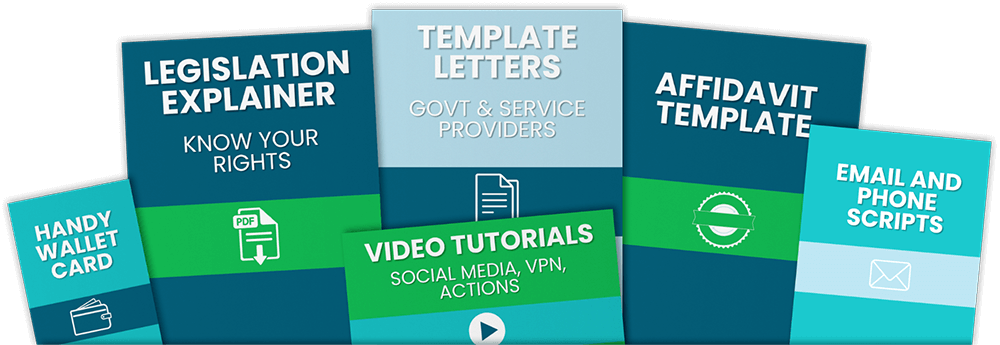
What's Included:
Download Your Free Digital ID RESIST KIT
Join Tens Of Thousands Of Aussies Learning How To Reject The Digital ID Control Grid To Stay Free & Maintain Privacy…

Along Your Digital ID Resist Kit—You'll Also Receive:
Watch The Video
Is this the future you want?
What Exactly IS A Digital ID?
A digital ID is touted as an easy and secure way to prove who you are online — similar to showing your driver's license, but on your phone.
The Government says it will help you log in to websites faster, access healthcare, or open bank accounts without passwords. It's presented as a tool for convenience, security, and inclusion.
In reality, Digital ID is the gateway to a complete tracking and control system, and global examples show where it leads.
In country after country, digital-ID systems have expanded from simple verification into a requirement for banking, healthcare, communications and travel.
Once everything runs through a single ID, every interaction you make, logging in, buying something, accessing services, or travelling, can be linked back to you, creating a detailed record of your behaviour that becomes very difficult to undo.
What IS The Social Media “Ban” for Under 16's — Really…?
Branded as protection. Delivered as surveillance.
Australia’s new under-16 social media law is the first nationwide move to normalise identity checks for online access.
To comply, platforms must introduce age-assurance tools, which may include ID checks, biometric scans, or third-party verification. While no single method is mandated, in practice the law creates the conditions to pressure you into accepting a Digital ID.
We're told this is to protect children from “online harm,” yet history shows that once the state begins deciding who may access what, the scope expands rapidly. Today it applies to under-16s on social media; tomorrow it could extend to news, forums, or viewpoints deemed “unsafe.”
Child safety measures are simply the first domino in a wider identity-verification regime — one that treats ordinary people as suspects who must prove who they are just to participate online.
The implications for privacy, security, and personal freedom are profound.
Instead of simply empowering parents to guide their own children, they're introducing a blunt, top-down mandate that shifts control away from families over to the state, replacing parental responsibility with government permission.
Equally alarming is that identity verification (such as third-party or government Digital ID) is often tied to biometrics—meaning your face or fingerprint becomes the basis of your permanent login. No anonymity. No real privacy.
If it gets hacked, unlike a password, you can't change your face or fingerprint. Once compromised, the fallout follows you for life, and biometric databases have already been breached many times globally. It’s only a matter of time!
What’s more, centralised identity systems don't shrink on their own. They evolve, expand, and embed. For proof, look at what life under China’s social credit system is like ⧉ — where one ID now underpins access, behaviour tracking, and control over every aspect of life.
If you don't want a different future, take action today, there’s much you can do.
What Are The Dangers?
ASK YOURSELF THIS:
If Digital ID were purely for your convenience, why are government agencies already requiring it for access to certain services — and why is the public being pushed toward age-verification just to use social media?
Because, behind the coercion and the glossy promises of “safety and convenience” sits an infrastructure that can restrict, monitor, and ultimately control how you live your life.
The State Of The Nation
Subheadline
Text
Highlight Text
Text
What Are Your Rights?
Section 74 of the Digital ID Act 2024 states clearly that Digital ID is not mandatory. By law, it is voluntary. But in practice, the government will try to make it feel like it’s your only option—making life increasingly difficult without it. Therefore, the solution is to know your rights and exercise them with conviction.
What Can You Do?
First of all, don’t panic. Making you feel powerless is part of their strategy — but you’re not powerless. Take a breath and focus on what you can do:
1. Learn
Knowledge is power
2. Take Action
Small steps add up quickly
3. Share
There is strength in numbers
Action Tracker: Reject Digital IDs
This Digital ID Toolkit campaign is an ‘Action Tracker’ project in association with RCR (Reality Check Radio) ⧉ and ACA (Aligned Council of Australia) ⧉. Action Tracker is a new initiative with the objective of keeping the government and industry accountable for the things they say and do.
Disclaimer: The Digital ID Toolkit contents are provided for general information only and are not legal advice. Everyone’s circumstances differ, so please consider your own situation and seek professional guidance if needed. Using or sharing these materials is entirely at your discretion and risk; we accept no responsibility for any outcomes. In the templates you may personalise only the clearly marked sections. If you adapt or share this material, please ensure the disclaimer is visible.